
Battered and depressed by the tragic details of the daily news updates and the frustrations of lockdown, it’s easy to lose sight of the big picture – and to forget that the Tory response to the Covid-19 crisis is governed by an extreme right-wing ideology which, when combined with the arrogance and greed of the British upper class, means that their decisions have little to do with saving lives, let alone the NHS.
But there are three key elements of Tory ideology we must not forget as we recoil in horror at what is happening:
- Lansley ‘reforms’ (aka as the 2012 Health and Social Care Act), which institutionalised competition within the NHS
- Austerity, which didn’t just starve the NHS of resources but led to follies such as the failure to replenish stockpiles of essential equipment despite the recommendations of Exercise Cygnus
- Privatisation at every level of the economy, shrinking the state and putting profit before people.
Add to these the poisonous concept of British exceptionalism, cultivated during and by Brexit and given free rein now Boris Johnson and his ‘advisers’ are in Downing Street –the appalling and avoidable result of which is that the UK tops the European death league – and we can begin to understand why we have had to experience:
- The herd immunity policy pushed by Downing Street’s eugenicists – more appropriately called the ‘cull the herd’ policy.
- The strategy of mitigation rather than suppression; the failure to comply with WHO guidance to test, trace and isolate; and the refusal to lockdown and close borders at a time when it may have prevented thousands of deaths.
- Boris’s Nightingale Hospitals – white elephants which diverted resources from existing hospitals and care homes. The questions about who profited from building these have yet to be asked.
- The disregard and indifference towards social care and care home residents and workers. Why should we be surprised by this when the Tories have repeatedly failed to come up with any social care policy for years, let alone one which would integrate a sector dominated by private companies with the public NHS?
- The refusal to work with Europe, not just on research and procurement, but now on data collection, with the Vote Leave data harvesters deeply involved in Downing Street’s preferred contact tracing App.
- Private companies involved at every level – for example Deloitte, G4S, Serco and Capita are all involved in one way or another with procurement and contact testing, with data harvesting a binary choice between the US tech giants and AI firms linked to the Tories’ cronies.
- The exposure of the health, wealth and race divides in our society, inequalities which have worsened over the past decade and which are now resulting in increased deaths in poor and multi-racial communities.
Now we must add messaging on easing the lockdown so muddled – as economic libertarianism comes into conflict with the public’s health – that key members of the Government have been unable to explain what we are all being advised to do.

Labour has a historically poor record of confronting the Tories on an ideological level, often letting them get away with pretending they haven’t really got one. Labour failed to challenge austerity until 2015. It tended to treat Brexit as a technical issue to do with trade and EU institutions rather than internationalism and solidarity, and was reluctant to call out its motivating mixture of deeply entrenched xenophobic bigotry, Atlanticism and the demands of a faction of capital. Labour’s response to the coronavirus crisis has similarly focussed on immediate issues rather than challenging the ideological reasons underlying the Tories’ failure to protect the health and lives of all their citizens.
This is to a large extent understandable whilst we are in the midst of the pandemic. Indeed, as one of those tagged with that horrible expression ‘extremely vulnerable’, my most frequently voiced criticism is why aren’t we all shouting louder and louder about the government’s catastrophic mismanagement of almost every single aspect of the crisis. But just as we mustn’t lose sight of the bigger picture in the now, we also need to be looking at it for the future.
One of the most depressing features of the global response to the pandemic has been the lack of international solidarity. Britain has not been alone in pursuing its own beggar thy neighbour policies. Trump’s xenophobia threatens the whole world.
The devastation being wrought by Covid-19 is massive. The global economy is in freefall, and because globalisation and technology have linked the world’s populations like never before, the coming depression will hit everyone. By the time the pandemic is under control, millions of working people across the world will have lost not just their lives or their loved ones, but their homes and their livelihoods. Hunger and destitution will make many desperate. Add the climate crisis to the pandemic crisis and humanity’s future is bleak if the most powerful countries continue to pursue what their strong men leaders perceive as their own national interests and fail to learn the importance of international solidarity and what could be the real meaning and strength of globalisation.
In this country, if it is left to the Tories, their new normal will be a return, with a few tweaks here and there – and with a lot of failed companies and thousands of unemployed workers – to the same old system of profit first people last. To this will be added the spice of a no deal Brexit at the end of the year. As many of us would love much of our lives to return to the way they were just a few weeks ago, it is going to be hard to challenge the ‘Britain will bounce back’ concept.
But we must. Labour has to seize the opportunity to articulate our values, challenge the Tories on an ideological level, and develop a new programme that really grasps the existential challenges the world faces. Our immediate demand has to be that workers neither in the developed north nor the global south pay for the pandemic through unemployment, tax rises and poorer public services. But we then need to go much further than that.
Our last manifesto was written for a different time and for a different economic situation. Some of its policies have shown themselves to be the most vital in the current situation – the much-mocked free broadband, nationalised railways, NHS investment; other policies such as a universal basic income and a national care service are now on the agenda. But our vision has to be even greater than any of those.
Experience during lockdown has shown both the vital role of the state and which aspects of our society and economy are valuable and essential, which are desirable, and which are unnecessary. If we are serious about tackling the climate crisis then that information must be used to inform a new transformative and radical economic and industrial strategy, which goes beyond the Green New Deal and addresses new ways of working, new ways of living, a shift in the balance between the public and private sectors, and the pressing need to alter the whole basis of income and wealth distribution.
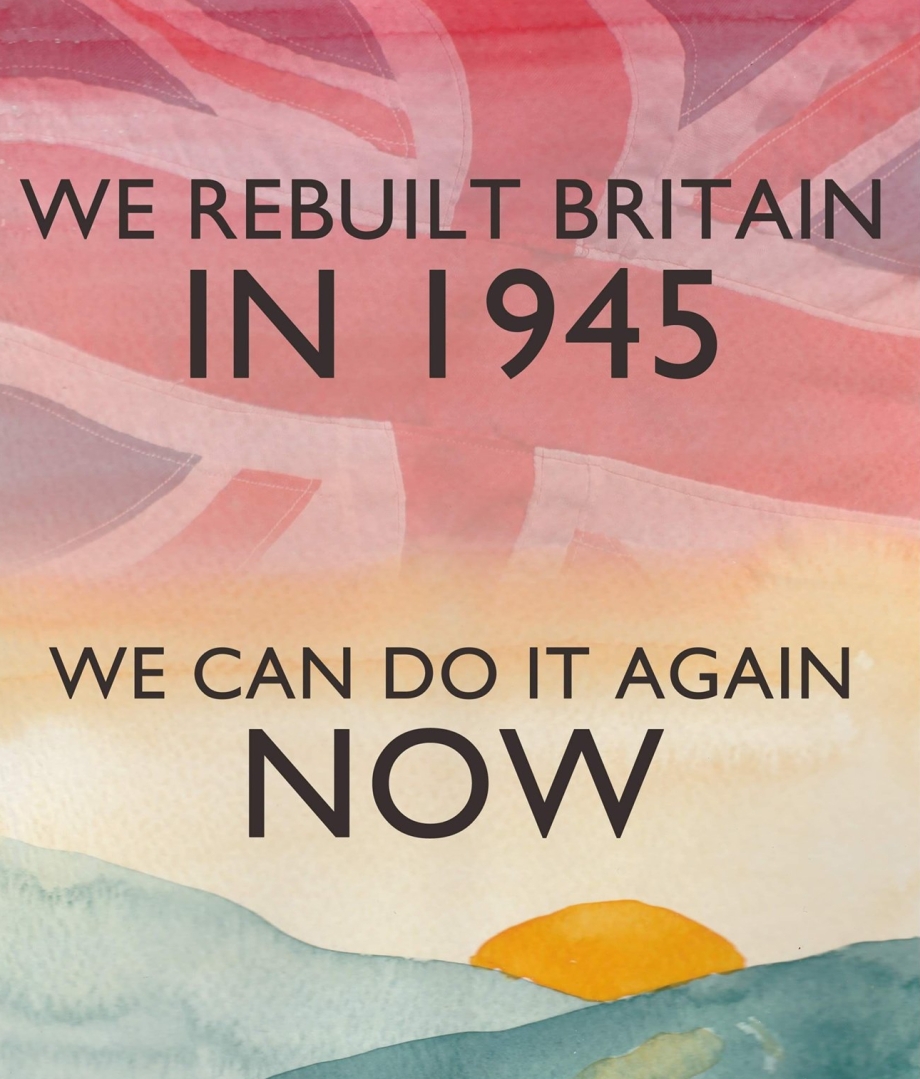
The world changed after the 1919 flu epidemic, and again following World War Two. VE Day was not just about an end to the fighting in Europe and the Allies’ collective defeat of fascism. It was a day of celebration and comradeship which paved the way for one of the most transformative periods in this country’s history. That did not happen by accident. We came together and restructured our society and economy to fight the war and rebuild after it, just as we are doing now in a smaller way to cope with the Covid pandemic. ‘No going back to the way things were’ applies just as much today as it did in 1945.
Keir Starmer rightly says we can’t go back to business as usual and that we must go forward with a vision of a better society. But what does that mean? And how do we turn the rhetoric into reality? Across the world most communities have responded to the crisis with kindness, neighbourliness, sympathy and collectivity. We must all, across the Labour movement, now make use of whatever downtime we have, and the way we can now use technology to talk to each other, to brainstorm new, imaginative and progressive ways of living and organising society. We must be ready to #BuildBackBetter; for a future based on our movement’s collective ideas, understanding and experiences; for a future which rejects the Tories’ right-wing virus breeding ground of fragmented public services, greed and survival of the fittest, and is founded on genuine solidarity and socialism.
 Joan Twelves