Assisted dying: Not the church, not the state, I will decide my fate

After Donald Trump’s Presidential victory, a far-right tweet triumphantly declaring “Your body, My choice” went viral. This misogynistic phrase all too sadly sums up the debate over abortion rights in the US. But it’s also relevant to the current debate on assisted dying in the UK.

I’ve spent over 50 years campaigning for a woman’s right to choose whether and when she gives birth. I cannot separate that belief, either morally, philosophically or politically, from my belief that I – and all others – must have a right to choose whether and when I live or die.

As a former local councillor, my instincts are those of a politician, but, while it is politicians who are going to decide on whether I can have the right to die at a time of my choosing, my unflinching support for assisted dying is rooted in my lived experience.

Since my late teens I’ve suffered from Crohn’s disease, a condition that is agonising and incurable. I had extensive abdominal surgery in my twenties and again in my forties, resulting in the permanent removal of my bowel and much of my lower intestine. Despite occasional periods of remission, I have lived all of my adult life with intense pain, unpredictable (and potentially fatal) intestinal blockages, and all the problems associated with living with a stoma. When I was first ill, hardly anyone had heard of Crohn’s, and explaining what I was going through was nigh on impossible. I don’t do pity, and nor do I want to listen to others’ squeamishness about my bodily functions…. So I rarely talk about it.

Crohn’s effectively stole the ‘90s and ‘00s from me – I had little energy, depression, brain fog, and only the barest interest in the politics which had been my life for the previous 20 years. When my late husband, Greg, become ill in the mid-‘00s it was a real struggle for me to care for him as I could barely care for myself.

New biological drugs gave me my life back in the early 2010s. But these wonder drugs, which I am still on, bring with them their own risks. Life expectancy for a woman with Crohn’s is nearly a decade less than the average. The biological and immunosuppressant drugs I have taken may be one of the reasons for that reduced life span. And, of course, Covid-19 loves to target those with weakened immunity, and the deadly threat of catching it has limited me to only the occasional trip into the outside world beyond my Estate since 2020. Am I facing another lost decade?

The greatest risk to my life is intestinal blockage caused by the strictures and lesions of my several operations. Getting to hospital for morphine and rehydration is urgent, and even with morphine plus added steroids the pain will continue for several days, and I will be ill for some time afterwards.

Crohn’s isn’t my only ailment. Most of my body is creaking from the effects of nearly 60 years of strong medications along with the wear and tear of age. In fact, these days when asked how I am, I usually respond with “still here” or “how long have you got to listen to my answer?” I officially have multiple chronic and complex comorbidities.

3 superwomen

Chronic illness has defined most my adult life, but, just as I have tried not to let it limit what I can do, I have no intention of giving up yet. However, I know that one day the pain may become unbearable, and I want to be able to decide for myself that I don’t want any more of it, that I’m done.

Much of the debate over assisted dying has focused on the state of palliative care – something I know a bit about. Before Greg died of throat cancer at the age of 54, he used to call the palliative care people the “Death Squad”. He had already lost his voice, and he knew that the pain medication on offer would soon take away his personality and identity. For him that would have been a living death, as it would for me. He wasn’t ready to die when he had a fatal arterial haemorrhage, but he had been told to ‘put his affairs in order’ – a chilling euphemism for saying it’s terminal.  

Palliative care works for some, but the arguments around assisted dying shouldn’t be a competition between improved palliative care and the right to die. In an advanced society, both should be available and both should be of equally high standard. Nobody should want to die because the palliative care isn’t good enough, or because hospices aren’t receiving the funding they need. On the other hand, nobody should be stopped from dying when they choose. Yes, robust protections must be in place to stop people being coerced into something they don’t want, but this risk isn’t a good enough excuse to deny those of us who truly want the right to choose when to die.

Think of it this way: Would any supporter of abortion rights argue that it should be illegal while we wait for our gynae or maternity services to be improved? Similarly, should the risk of a young women being coerced into an abortion she doesn’t want mean that nobody else should be allowed to have one? The answer is clearly no and, much like abortion, assisted dying will continue to happen, so enshrining rights and protections into law will mean there can be proper safeguards to protect the vulnerable.
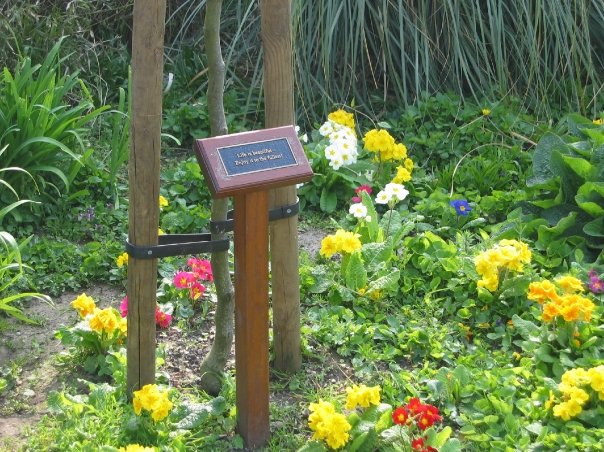
plaque amid flowers
Life is Beautiful – Enjoy it to the full
Dedicated to Greg Tucker

To me the concept of a ‘slippery slope’ just doesn’t hold water. Did its advocates not notice the landslide at the height of the pandemic, when thousands were assisted to die without any choice?

The blame for these avoidable deaths – the second worst death toll in western Europe – must be laid at the door of a government who, as well as being scandalously unprepared and who had starved the NHS of funds for a decade, presided over a situation where our rights were violated as blanket Do Not Attempt Resuscitation notices were used, and access to critical care denied. 60% of Covid deaths were those of disabled people. And those of us who have to continue to self-isolate to protect ourselves against the virus receive no acknowledgement or support.

There has always been a strong eugenicist strain within British society – and not just among those members of the upper class who would happily dispose of those they consider lesser beings.

As Jonathan Friedland wrote in 1997 “Eugenics is the dirty little secret of the British left. The names of the first champions read like a roll call of British socialism’s best and brightest: Sidney and Beatrice Webb, George Bernard Shaw, Harold Laski, John Maynard Keynes, Marie Stopes, the New Statesman even, lamentably, the Manchester Guardian. Nearly every one of the left’s most cherished, iconic figures espoused views which today’s progressives would find repulsive.”

I remember demonstrating against Keith Joseph at Essex University in the ‘70s when he was advocating preventing mothers ‘least fitted’ to bring children into the world from giving birth. He would have applauded the two-child benefit cap, a policy introduced by the George Osborne but still defended by Labour government ministers.

The violation of the rights of disabled people did not end with the declaration that the pandemic is over, or with the removal of the Tory government. The eugenicist state continues to infringe disabled rights with near impunity. Cuts to disability benefits show how easy it is for any government to get away with putting the most vulnerable in the firing line.

But the fight against eugenics and discrimination against disabled people must be distinct from the right to assisted dying.

There shouldn’t be a trade-off between disabled rights and others’ right to die with dignity.

Quality support, anti-coercion measures, and clear regulations are essential, regardless of whether assisted dying becomes law. But if it does, then clear and enforceable measures, untainted by prejudice, must be crafted to ensure that choosing an end to suffering is an option born of freedom, not desperation.

While the scars of the pandemic remind us of the fragility of our rights, they also provide a blueprint for reform. Whether through enhanced care provision, strengthened legislation, or societal education, the responsibility lies in creating an environment where dignity is preserved – not only in life but also in death. The battle to protect lives and the right to end them are not mutually exclusive; they are intertwined in the fabric of human rights.

The parallels between the right to choose abortion or assisted dying are always strong. When abortion was illegal in the UK, Harley Street was there to help those who could pay. The same is true today in respect of assisted dying. The rich will go to Switzerland while the rest of us cry out for more morphine.

MPs may be struggling to come to a decision on this matter, but the UK public are crystal clear in their views. The YouGov tracker poll in May 2025 showed 70% in favour of the law being changed to allow someone to assist in the suicide of someone suffering from a terminal illness, and only 13% opposed.

Whatever our politicians decide, support for assisted dying isn’t going away. Although there are many sincere concerns about the proposals, there doesn’t seem to be anything that scrutiny during the passage of the Bill and more investment in palliative care couldn’t fix. We must grasp this chance and ensure that dignity in death is a fundamental right down to the choice of the individual, not the state.

This was first published in November 2024, just before the 2nd Reading of Kim Leadbeater MP’s Terminally Ill Adults (End of Life) Bill. It has been amended and updated just before the 3rd Reading of the Bill in June 2025.
Where’s Covid Gone?

Is it Covid? Or is it a cold? Co-vold? Col-vid?

Is this the question you’re asking yourself as your throat feels as though it’s lined with sandpaper?

I want to call this pseudoword Co-void because we’re so de-void of information that Covid and Pandemic are rapidly becoming words about the distant past rather than about the realities of our collective present.

Nature abhors a vacuum, a void, and politicians are rapidly filling our shared memories with heroic stories of furloughs and jobs saved, not of thousands of avoidable deaths, boozy parties, eat-outs and corrupt contracts, while we, the public, nervously await the next infection or climate disaster.

Some of the approaching climate emergency is visible – the sewage, the floods, the storms, the rain, the crumbling cliffs. And that’s just on our little island. Globally thousands are dying or being forced to leave their homes and livelihoods as politicians and corporations mumble about achieving net zero, which, like Co-void, means nothing anymore.

Less visible is the probability of another pandemic. Climate change and pandemics go hand in hand as ecological change makes the transmission of diseases and viruses between species more likely.

For example, Avian flu (H5N1) has been racing through the global bird population with devastating impact since 2020, and has been documented in other animal species, such as seals and cats. The WHO has warned of its potential to cause a new pandemic, with increasing signs of sufficient mammal to mammal transmission to cause concern for a jump to significant human to human transmission.

Not only do most of us not grasp the potential risks of what is rapidly coming down the track towards us, such is the low level of information being given to the general public, but even with covid, which most people got to know a lot about over the past four years, the lack of up-to-date information is such that we don’t even know whether to still call it a pandemic. Is it now an epidemic? Is it endemic? Is it global or regional? Is it still mutating? Could the next wave be less or more intense, more or less deadly?

One of the reasons we don’t know is that across the western world governments, without adequate scientific or medical evidence, have decided that covid is here to stay but must be ignored if life (by which they mean trade and profits, not your personal existence) is to go on ‘as normal’. Just as the further destruction of the climate cannot be mentioned in the same breath as the constant search for economic growth, so any admission that the global labour force is sick and producing less surplus value cannot be countenanced.

Yet, as Christina Pagel points out, Covid remains a serious disease, and there needs to be further urgent research into better, longer lasting vaccines; effective treatments for (and prevention of) Long Covid; and the implications of repeated covid infection on longer term health problems such as heart issues, diabetes, cognitive function.

In the UK (and many other places), free Covid tests are hard to come by, even for those deemed the most vulnerable, vaccines are restricted to the old and infirm, and the mitigations which would make such a difference to preventing the spread of Covid and other airborne respiratory diseases – masking in indoor public spaces, filtration and clean air – are rare.

Data collection and surveys are severely restricted by funding cuts, research into the causes of Long Covid is not prioritised, sick pay and benefits are kept low, and those showing signs of illness are still ordered into school, college and work.

The data which is available is telling us that a recent rise in Covid cases has waned, and that deaths and hospital admissions have plateaued.

Yet the empirical evidence of word on the street contradicts this, with many saying they may have covid but without tests they don’t know, so it’s ‘fingers crossed’ that it’s just a really heavy cold. This is similar to the chat before Christmas 2023 when everyone was saying ‘there’s a lot of Covid around’ as they prepared for seasonal get-togethers, and it was only later that the data confirmed this.

It took a lot of campaigning by bereaved families and others to get the Independent Inquiry into Covid-19 set up, and its final reports won’t see the light of day before 2027, although it is scheduled to give a preliminary report on module 1 (resilience and preparedness) this summer. The public inquiry into the infected blood scandal from the 70s and 80s didn’t begin until 2018 and has only just reported.

The British state is singularly good at kicking problems into the long grass of lengthy inquiries, singularly bad at learning from their findings, and singularly good at gaslighting us into believing nothing is wrong.

We can’t expect the Hallett Inquiry to rescue us from the state’s current failure to protect its citizens from disease and death. It’s not one of its modules.

A general election is meant to be about giving the people (us) a voice – and therefore should be a good time to ask questions. Not just of the most likely next government, but of all who want our votes. So – will Co-void continue into a change of government?

We know what the Tories will do if they get returned to power. But Google is silent on Labour’s policies on Covid. No wonder, as their front bench have been as mute as the Tories on its continued existence and transmission through our communities.

It is rumoured that Labour has a sh*tlist of all the nasties the Tories are leaving them to deal with – from sewage to no money. If Covid isn’t on that sh*tlist, then it needs to be!

Here are some of the questions Labour’s leadership and candidates (and representatives of any other Party who want the votes of the thousands who have lost loved ones, the millions suffering from Long Covid, the vulnerable millions still locked away from society) need to answer as they campaign for our votes.

Some have no monetary cost. Others do, but measures to prevent infection and sickness will more than pay for themselves, will go a long way to restoring the NHS, and improving the health of the nation.

Questions for future Parliamentarians

Will you call on the next Government to….

  1. make Covid an occupational disease, and Long Covid recognised as a disability under equality legislation?
  2. make tests freely available to everyone and restore regular testing of staff and patients in hospitals and care homes?
  3. restore data collection and surveys, such as ONS survey and other research programmes and projects on prevalence of Covid-19, and potential new variants of SARS and other viral threats?
  4. follow the example of the Mayor of London and institute a programme of installing air filtration systems in schools, colleges, hospitals and care homes?
  5. provide free booster vaccines for all those who want them?
  6. provide specialist clinics and support for Long Covid sufferers, and a programme of research into its causes?
  7. review the infection prevention and control guidelines?
  8. restore the tasks of testing and tracing any new disease to local authority public health specialists?
  9. increase sick pay?
  10. raise covid awareness by providing public information that covid is still here and that it is an airborne disease?
  11. fund not-for-profit research to develop new vaccines and antiviral drugs?
  12. vigorously go after the covid-profiteers and fraudsters?
  13. ensure that the NHS, public health authorities and other agencies are fully prepared for any new health threats to the population, including fully stocked with PPE?

This list of questions can be sent to every candidate in the election. And then the question is, will any of them answer?

Or will Co-void continue until the next deadly variant or new pandemic threat hits the world again?

Published in Labour Hub, 28 May 2024

Expectations of the Future – Remembering Hope

Every term my writing group is given a topic/theme to write a short piece about, to be presented at the last session of the term. In December 2023 the topic was Great Expectations and this is what I wrote.

The past is memory. The future is hope.

But what about the present?

If our memories influence our present, the way we experience the world around us, then how do we tell the difference? What is memory and what is real?

For example,

My body knows her hands. It knows her mouth. It knows her smell. It knows the way she responds to my caress, and I to hers. It knows the places her fingers go. My fingers go with hers. We entwine to arouse each other, to open the way for the memories to satisfy.

But how long will my body remember? Will the memories fade? Will satisfaction become harder and harder to remember? When will it become a false memory? Is it already fake?

Is it just a dream? Is it all a dream?

Can I expect to be interrupted by the sound of Nick Robinson’s voice bringing me back to the present?

The leak of radioactive liquid from one of the “highest nuclear hazards in the UK” – a decaying building at the vast Cumbrian site – is likely to continue to 2050.

I can’t remember his voice. But I can hear his words. He wasn’t one to voice words of endearment. His body expressed those. We loved to argue, and then we loved to make up. I can hear his exhortations to be strong, to fight for what’s right, not to give up.

Tipping points in the Earth system pose threats of a magnitude never faced by humanity. They can trigger devastating domino effects, including the loss of whole ecosystems and capacity to grow staple crops, with societal impacts including mass displacement, political instability, and financial collapse. The tipping points at risk include the collapse of big ice sheets in Greenland and the West Antarctic, the widespread thawing of permafrost, the death of coral reefs in warm waters, and the collapse of one oceanic current in the North Atlantic.

But how long will I hear and take strength from his words? How do you not give up when the present is war, famine, pestilence, death. When the present is Afghanistan, Ethiopia, Libya, Somalia, South Sudan, Syria?

When the present is Ukraine.

Ukraine’s first lady, Olena Zelenska, has warned that Ukrainians are in “mortal danger” of being left to die.

When the present is Gaza.

António Guterres, the UN’s secretary general, told a meeting of the security council in New York: “We are at a breaking point. There is a high risk of a total collapse of the humanitarian system.” People are “desperate, fearful and angry” and are “looking into the abyss”.

If this is the present, what of the future? Can we even expect a future?

I curl up and close my eyes, willing myself to go back to my lovers, to shut out the present, to go back to a world of memories, hope and expectation.

A small concession?

The Government has finally been forced to concede that the Covid-19 Pandemic is not over, and that the virus is continuing to infect our communities.

According to the latest risk assessment by UKHSA, the latest new variant, BA.2.86, has a high number of mutations and has appeared in several countries in individuals without travel history.

Consequently, the autumn vaccination booster programme has been brought forward a month to start on 11 September.

But this booster programme is very limited, restricted as it is just to people in care homes for older people, the clinically vulnerable, those aged 65 and over, health and social care staff, and carers.

No other mitigation measures are proposed to prevent community transmission of this new variant and its mutations. Increasing Covid infection does not just mean more avoidable deaths (152 people died across the UK in the week ending 18 August according to the ONS) and the risk of Long Covid affecting many for years to come, but it also damages our NHS and the whole economy.

“Why are booster jabs not being offered to everyone who wants one?” asks Joan Twelves of the Covid Action campaign. “It’s several years now since the majority of the population were offered vaccination. Depending on illusory herd immunity and assuming everyone has already been infected is bad science, and ignores the reality, which is  that one infection does not prevent all future infections. It further ignores the fact that Covid’s variants and mutations make re-infection all the more likely.

“Take-up of previous booster programmes has been low because they were not publicised. Vaccine centres need to be reopened and a mass publicity campaign launched explaining why vaccination is still important.

“Vaccination is not the only protection against Covid we need. Simple measures such as wearing good masks in all healthcare settings and crowded public spaces, and decent ventilation in schools and community buildings should be reintroduced.

“If the government really wants to say that the pandemic is over then it should be taking measures to halt community transmission. For more than a year it has been in denial that the virus is still spreading and infecting us. It has been able to pretend that we are living with covid by withdrawing free tests and shutting down data collection and surveillance. This small concession that we are all still at risk is just that – a small concession.

“With schools and colleges about to open, now is the time for a radical change in government policy on the virus. Offering free vaccinations to all, reintroducing testing and mask wearing, and installing decent ventilation is the least the government should be doing to protect us now as we are about to enter a hugely challenging period for our massively overstretched health service.”

Press release issued by Covid Action, 31 August 2023

The first duty of government should be to protect its people, not prepare the body bags

Module 1 of the Covid Inquiry has exposed the callousness and uncaring nature of the British state and its institutions.

The first duty of government should be to protect its people, not prepare the body bags.

More than a decade of austerity – imposed on the British people to pay the banks for crashing the global economy in 2008, and justified by Cameron and Osborne in their evidence to the Inquiry as preparing the economy to better face the pandemic – had brought the NHS and other public services to their knees even before Covid hit.

The probing questions of Baroness Hallett’s legal team have revealed a sorry tale of recommendations being ignored, an ideological approach totally at odds to scientific and historical methods of preventing viral infections, Brexit diverting civil service resources, questions unasked and assumptions made. 

After the scandal of Partygate, the British public can hardly be surprised by these revelations. But that does not make them any more palatable.

Sioux Vosper a member of Covid Bereaved Families for Justice, who lost her father in April 2020, and who has sat through every day of Module 1, says:

“Bereaved families’ stories were finally heard at the Inquiry at the end of Module 1. This was very much needed to bring the human element into the Inquiry after hearing about statistics, the economy, logistics, groups and subgroups, spaghetti charts and acronyms for six weeks. Everyone was visibly moved by our speakers, who spoke so eloquently, with dignity and from the heart. Bereaved families have been verbally abused online and in person by covid deniers and anti-vaxxers. All we want is for lessons to be learned; we don’t want anyone to go through what we have. It won’t bring back our loved ones but if our stories prepare us for the next pandemic (it will happen again) the last three years of campaigning will have been worth it. Our loved ones won’t have died in vain.”

Joan Twelves from Covid Action UK added: “The purpose of the Inquiry must be to learn the lessons of the tragedy of the past three years so that we are better prepared to stop any future pandemics leading to such a disastrous and heartbreaking death toll. The omens are not good. Across the western world governments are removing mitigations and protections, reducing data collection and the availability of vaccines. Covid has not gone away. We are campaigning along with many other groups for masking in all healthcare settings and care homes, clean air and decent ventilation in all public building, the availability of vaccines for all who want them, financial and practical support for Long Covid sufferers, and the return of free testing.”

Press release issued by Covid Action, 20 July 2023

It’s the Covid cover-up, stupid!

The UK Covid-19 Inquiry has only just got underway, but it is already hitting the headlines. Not only is the government challenging the Inquiry’s Chair’s right to see the former PM’s unredacted notebooks and WhatsApp messages, but it has said that it expects to ‘security check’ witness statements.

In other words, the government will censor anything which it decides ‘undermines the government’s position’.

Few have ever accused this Tory government of being competent. But it is singularly inept to reveal your plans for a cover-up in advance.

Ben Jennings, Guardian

It took years of pressure for the Inquiry to be set up, and then there were long delays while its terms of reference were sorted out. It has a massive agenda and, like most such inquiries, it is expected to take several years. The Chair has said she aims to conclude public hearings by summer 2026. Delaying it in order to conceal evidence is not just an insult to the bereaved and their families but to every UK resident. Every single one of us has been affected one way or another by Covid-19. We all have a right to know everything about the government’s handling of the pandemic.

It is not just in the UK that questions are being asked.

According to the Guardian, criminal investigations are underway in France, as well as parliamentary enquiries to ascertain whether ministers were prepared, and whether their policy U-turns – such as on masks and lockdowns – reflected evolving scientific knowledge, or political shortcomings.

In Italy politicians face possible prosecution, with a judicial inquiry focusing on authorities’ alleged failure to save an estimated 4,000 lives in Bergamo by quarantining affected towns earlier, and the absence of an up-to-date national pandemic plan, with the current version dating back to 2006.

A corruption investigation is under way in Bavaria into allegations that some regional conservative politicians earned large sums in commissions on contracts for masks struck by the regional government during the first wave of the pandemic.

In contrast, Sweden’s Covid Commission reported in February 2022 that its broad policy and relaxed attitude to restrictions was “fundamentally correct”.

Here, the People’s Covid Inquiry in 2021 found the government guilty of misconduct in public office.

Which of these will the Inquiry emulate? Will there be prosecutions? Will the 226,278 people who have died get any kind of justice? Or will they be written off as the unavoidable casualties of a government which did its best under difficult circumstances.

There are myriad questions to be answered. The first is what are they hiding?

Is the revelation before the Inquiry has even started that the government intends to redact texts and documents just clever expectation management so that, when the words concealed by those black lines are inevitably leaked, we don’t dig any deeper and ask what else is there? How many other phones haven’t been handed over? What has been left out of witness statements? Who said what to whom over the phone, on an unrecorded Zoom or Teams call, or at one of those parties which didn’t happen?

And what about the phone Johnson used for most of the pandemic? The one which is conveniently ‘locked’ for ‘security’ reasons, and which requires government techies to unlock?

I don’t expect the Inquiry to question the ideological underpinning of so many of the Government’s choices, choices rarely questioned by the Opposition. If your starting point is neoliberalist individualism rather than collectivity, competition rather than mutuality, big business rather than public health, a small state rather than a welfare state, then you are not going to meet the governmental and leadership challenges of a global pandemic.

And while the Inquiry’s modules cover many of the obvious issues – and it will be fascinating to see how some of the more egregious are justified by witnesses such as Cameron and Osborne, Johnson, Hancock, and Sunak – some will inevitably be missed or insufficiently probed.

  • What effect did a decade of Tory austerity and cuts across the public sector (as reported by the TUC), the Lansley reorganisation of the NHS and public health, which institutionalised competition within the NHS, and the failure to integrate health and social care have on the ability of the state to prepare for and manage a pandemic?
  • Why were the findings of Exercise Cygnus ignored? The UK’s preparedness and response in terms of plans, policies and capability, is currently not sufficient to cope with the extreme demands of a severe pandemic that will have a nationwide impact across all sectors’.  Why were stockpiles of essential equipment not replenished?
  • What were the ‘irrelevant’ activities keeping the PM from attending Cobra meetings until 2 March 2020?
  • Why were lockdowns repeatedly delayed, thereby increasing the number of avoidable deaths?
  • Who decided not to test patients being transferred from hospitals into care homes – which contributed to 19,783 deaths in the first wave between March and September 2020? The High Court ruled this was unlawful – so why has nobody been prosecuted?
  • Who or what took precedence in government decision-making? The economy or public health? Mainstream scientists or right-wing eugenicists? Supporters of the Great Barrington Declaration and herd immunity or public health experts and professionals?
  • Who was responsible for:
  • spending £840 million on the Eat Out to Help Out Super Spreader scheme while ignoring calls to feed kids during school holidays?
  • agreeing to £47 billion bounce-back loans, £4.9 billion of which the government itself estimates were fraudulent, and the £17 billion more it expects won’t be repaid?
  • refusing to increase sick pay to a realistic level?
  • Why did the government promise laptops and improved ventilation for schools and then not deliver them? How does the government justify refusing to provide sufficient recovery support for schools?
  • Why has the collection of data on Covid-19 infections and deaths been stopped?

These are just for starters.

The government spent billions on the pandemic, but too much of it was spent lining the pockets of the big supermarkets and the big consultancy and outsourcing firms. Due diligence and fraud controls were ignored when it came to their chums. Those billions did not find its way into the purses and wallets of either those forced to quarantine or shield, or the key public sector workers who risked their lives to care and feed us, and who are now being asked to pay for the pandemic through wage cuts.

Given that the government is now pretending that the pandemic didn’t happen – “don’t mention the virus” – let alone that it is ongoing, we can expect much obfuscation and self-justification from them. However, they are not the only witnesses.

Bereaved families, respected academics and scientists, public health experts, will all be giving evidence and we must hope that they bring clarity and truth to what was and is one of the grimmest periods in our lives.

Published in Labour Hub, 7 June 2023

On Covid, the past is being erased and the present ignored

Letter published in the Guardian, 1 June 2023

‘Don’t mention the virus’ has become a mantra, says Joan Twelves, while Joe Sim and Steve Tombs say the government is silencing discussion about the disease. Plus one reader describes how her husband’s death was not recorded as caused by Covid

John Harris is right. It’s as though the pandemic never happened. The long-term effects it has had on our and our children’s mental and physical health, our NHS, our public services, as well as the global economy, have been swept under the carpet. ‘Don’t mention the virus’ has become the guiding mantra of our media and our politicians.

The past is being erased. The present is being ignored. Even though the pandemic is still with us, all protections, surveillance, and data collections have been dismantled. Those millions still at the highest risk are reporting being told to take their masks off in hospitals. The over quarter of a million people who died from Covid – and their millions of grieving friends and relatives – are no longer even a number.

Let us hope that the Independent Inquiry doesn’t just become about Partygate, or even Cronygate. We owe it to the dead and those who are still dying (nearly 300 a week according to statistics from the end of April) to learn the lessons of such a traumatic and long-lasting period in all our lives, recognise that Covid is still with us, and ensure that we are prepared for any future pandemics.

For Covid-safe trade union and Labour meetings!

A cozy, slightly out of focus picture of a zoom call.

For months now the Tory UK government has been gaslighting us into believing the Covid pandemic is over, even though most people’s experience is that they or someone they know is or has just been sick. Nearly one million UK residents had Covid last week, with over 7,000 hospitalised – their care and the need for barrier nursing and infection control adding further stress to the overstretched NHS.

And more than 130 people are dying every day.

The figures have gone down from their tragic heights earlier in the pandemic, largely thanks to vaccination, but no avoidable death can possibly be acceptable.

And nor should we accept preventable infection and reinfection from a virus which can cause not just immediate unpleasant sickness but long-term damage to our health.

A million workers off sick with Covid, added to the 2 million with Long Covid, is one of the unreported reasons why so many industries and services – especially the NHS – are short-staffed and unable to deliver to acceptable standards. For thousands, sick pay is non-existent; for those who are entitled, it is inadequate.

But let’s not mention Covid (or Brexit, for that matter) when we can blame strikers!

The Kraken is coming….

Sadly, many of our friends and comrades have accepted being gaslighted into shrugging off all protections and mitigations and, in so doing, putting their own and others’ health and lives at risk.

An airborne virus like Covid spreads when people inhale its miniscule aerosols. Transmission of the highly infectious Omicron (or the even more infectious Kraken subvariant, which is now spreading fast) is undetectable. Good ventilation and the installation of CO2 monitors and HEPA filters is crucial, especially in public buildings and workplaces. Where ventilation is poor, or the room crowded, masks are our protection.

My mask protects you! Your liberty infects me!

So why have so many intelligent, caring socialists accepted the line that wearing a mask is an infringement on their liberty?

No, it’s not. It’s an infringement of mine. When I wear a mask, I am protecting you from any infection I may have. When you don’t wear one, I am the person who could get infected.

At the height of the pandemic, most people seemed to understand that. How short their memories have become!

Those of us whose vulnerability to Covid has not much diminished, and those who keep adding to our numbers as they are diagnosed with cancer, auto-immune diseases, diabetes or other disabling illnesses, as well as those who live with us, are finding ourselves increasingly isolated, just as thousands of disabled people have been for generations.

In the past becoming housebound by age, disability or infirmity meant an end to political involvement. But just as technological advances in recent decades mean that mobile phones, social media, emails, texting and messaging have become standard tools for any activist, so now online video calls are enabling participation in democratic discussion and decision making for those who previously were excluded.

But just as there are still holdouts against mobile phones, we are now encountering unwarranted opposition to hybrid meetings. It’s as though those of us who are housebound are determined to take away comrades’ right to meet in person before going to the pub, rather than tentatively asking to be allowed to join in the non-pub part.

The arguments against hybrid can be gob smacking – we can only do hybrid with hi-tech systems; I spend all day at work on zoom so refuse to do it after 5pm; we can’t do hybrid because hiring halls with the facilities may cost us; we could alternate zoom and in person meetings (would anyone suggest women or black comrades could only come to 50% of meetings?).

Disability is a protected characteristic under the Equalities Act, yet discrimination against us is rife and goes unchallenged. (Yes, I know many reading this will have had to put up with it for all or large chunks of their lives, but that doesn’t make it any more acceptable.)

Covid Action activists are sick of being the only person wearing a mask at a labour movement meeting, sick of arguing to be allowed to join via zoom, sick of explaining that meeting in a room with no ventilation is dangerous.

There are so many bigger battles to be fought in respect of Covid – against the closure of the vaccination programme for under 50s; the fight for airborne pathogens to be included in clean air legislation; for improved sick pay; for Long Covid research and care; for the need for continued funding for research and surveys; against the Tories’ refusal to properly fund the public sector, not just the NHS but local authorities, civil servants and the care sector, so that in the event of the almost inevitable next pandemic we won’t be faced with the same inadequate preparations as we were in 2020. And then there’s the Independent Inquiry reminding us of the venality and negligence of the Tory government’s handling of the pandemic.

Covid has not gone away. At the very least the labour movement should be demanding the most basic of health and safety measures and inclusivity in its own workplaces and at its own meetings, rallies and conferences by encouraging mask wearing and facilitating hybrid meetings.

Published on the Covid Action website on 5 February 2023

The Johnson government may be on its way out, but Covid isn’t.

More than 200,000 people have died from Covid in the UK during Johnson’s rule, 294 of them in the past week.There are 11,500 patients in hospital with Covid – and the number of hospitalisations is rising, adding to the burden on the already overstretched NHS.

3.5 million people are currently infected – a rise of 30% from the previous week.

The UK has one of the highest death tolls in Europe, with 2,689 deaths per million people.

These grim numbers are rarely reported any more. We have supposedly moved into the post-pandemic era.

Like the Tories, the media have got bored with the Covid plague, now well into its third year. And most of us go along with that because we are all fed up with it as well. We want to socialise, meet our friends and family, go to parties, gigs and demos. Or just down the pub.

And we’ve all got enough to cope with trying to make our money stretch to pay for the weekly food shop, petrol and energy bills without having to worry about finding more to pay for masks or Covid tests.

But we must resist the normalisation of Covid and letting it rip through our society. We cannot and must not accept the continuing deaths, the high infection rates, the reinfections, the disruption to all our lives caused by sudden illness, unplanned absences, shortages, cancelled appointments and holidays. We cannot and must not accept the failure of a government whose first duty should be to protect its population whether that is from disease, starvation or war, especially when there is an alternative to ‘Living with Covid’, an alternative based on well-established age-old measures for protecting communities against infectious diseases through contact tracing and isolation.

Relief at the departure of Boris Johnson has to be tempered by the recognition that, while his famed sloppiness, dishonesty, selfishness and incompetence played their part, the failure of the Conservative government to handle the pandemic is ideological and not primarily a result of him as an individual.

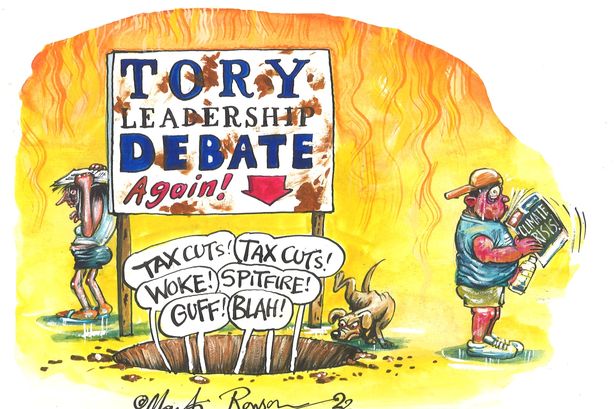
That ideology is embraced by all of Johnson’s potential successors and exposed by their clamour for tax cuts and shrinking the state. Just as Johnson and Sunak have been trying to lay the costs of the pandemic onto working people with their dogmatic refusal to increase pay in line with inflation, so we are witnessing the grotesque spectacle of a line-up of B-list hopefuls competing to cut benefits and public services to pay for their ambitions.

Martin Rowson, The Mirror

In their parallel universe of voodoo economics, where inflation, food banks, hungry children, homelessness, increasing inequality, industrial unrest, soaring prices, energy and petrol costs, a collapsing pound, climate catastrophe, and most certainly a continuing Covid pandemic, do not exist, economic illiteracy is being paraded around the media studios as a badge of pride.

The crisis in our health service is far less important to them than their own faux-sincerity. Their newly vaunted moral principles and integrity haven’t been much on display in recent months when most of them defended the Partygate lies, the repugnant Rwandan deal and the suppression of dissent.

The NHS is not safe in any of their hands!

Martin Rowson, The Guardian

Nor is it safe in the hands of the loyalist Johnson quickly shifted from a short stint as his chief of staff to Health Secretary when Javid resigned.

Javid is a eugenicist who washed his hands of Covid almost as soon as he took over, happy for Johnson to cave in to the demands of the anti-vax, anti-mask Covid Recovery Group to remove all mitigations and protections.

Like Javid, Steve Barclay considers Covid over and done with. Back in January he was tweeting: “Now we’re learning to live with Covid, we need to get back to face-to-face working.”

Barclay is deemed to be even worse than his predecessor. The Health Service Journal’s editor, Alastair McLellan, says of him: “A real nightmare, vindictive, arrogant, a bully, hostile to the NHS and all its works, a micro-manager of the wrong things, views NHS management as bloated and profligate …… Never has a politician arrived in the post of health secretary … trailing a worse reputation than Steve Barclay.”

Zero Covid has launched an online letter writing campaign to remind him that Covid isn’t over and that he needs to take action to mitigate the effects of the virus now by implementing basic public health measures to protect us and reduce community transmission.

In recent months, the Tories have relied solely on the vaccination programme – and the vaccines have been crucial in reducing deaths and serious illness. But the current dominant strain of Omicron and its more transmissible sub-variants are breaking through the vaccine barriers so that reinfection is becoming increasingly common. And the vaccines have never been enough on their own. Simple, non-restrictive additional protective measures are needed if we are to stamp down on the virus.

Masks in public places, free tests, contact tracing, social distancing, decent sick pay, Covid-safe workplaces, enforceable air quality standards, Long Covid to be classified as a disability, autumn booster vaccinations for all, funding for research, monitoring and the now urgent development of the next generation of vaccines, and for this disgraceful government to support WTO patent waivers so that we vaccinate the world.

With his cut-price Trumpian populist approach to Covid, Johnson is leaving behind a legacy of social murder, waste, corruption and callousness. He is going as the death toll hits 200,000 deaths. 200,000 avoidable deaths. 200,000 people who have left behind grieving family and friends.

On top of that there are at least 2 million people suffering from Long Covid, possibly facing years if not a lifetime of pain, depression, fatigue, lost dreams and missed opportunities.

Not to forget the 4 million or so of those of us who remain at high risk from Covid and who, notwithstanding vaccines and anti-virals, have been abandoned not just by the government but by the rest of society to continue to shield ourselves in isolation behind our front doors.

Having delayed the Independent Inquiry into his government’s handling of the pandemic for so long, we must not allow Johnson and his chums to escape its judgments as it puts the deaths in care homes, the delayed lockdowns, the corrupt PPE contracts, the billions spent on the failed Test and Trace scheme, the fraudulent bounce-back loans, and so much more, under the microscope of public accountability.

The pandemic has caused untold damage to our society. Everybody bears the scars in one way or other. It has been global in its harm, but it has been so much worse in the UK than it needed to be.

We must not forgive, and we must not forget. And, whoever ends up leading it, we must not let this corrupt and callous government get away with pretending that the Covid pandemic is over. However much we may all wish it away, it is still with us, and it is still killing people.

Published in Labour Outlook 15 July 2022

World Health Organisation advice

The Pandemic is not over

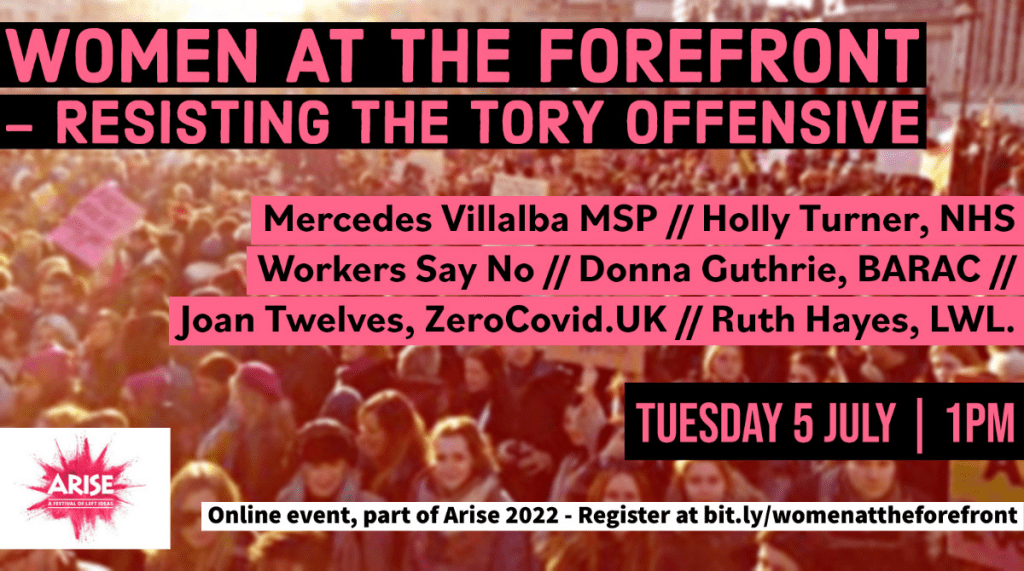
Below is the text of my speech to Women At the Forefront – Resisting the Tory Offensive @Arise Festival 2022 on 5 July 2022. The video of the meeting can be found here

Thanks to Arise for holding their festival online and not falling for the government’s gaslighting and accepting the normalisation of Covid. Sadly, far too many labour movement organisations are going along with it, holding in-person conferences and meetings without social distancing or facilities for online participation by those not just at high risk of catching Covid but also carers, those with disabilities and those who have to be at work. For some of us, online meetings have been one of the rare positives which have come out of the past two and a half years. Let’s make sure we keep them!

Anyway, thanks Arise for recognising that the PANDEMIC IS NOT OVER. Indeed, we are now in a rising fifth wave of this deadly, debilitating virus. The government has tried to get rid of monitoring programmes, and the ONS data we are getting is a week out of date, but even so we know that nearly 2 million people had Covid last week, 1 in 30 people in England, 1 in 18 in Scotland. A rise of 30% on the previous week. Nearly 10,000 people are in hospital with Covid.

The idea that we can live with Covid is absurd. Covid is not flu. It is not a cold. Omicron, and now its variants BA4/5, is highly contagious and even in its mildest form can lead to long term illness and incapacity. Reinfections are now becoming commonplace as the virus breaks through antibody and vaccine protections. And the more virus there is in the population the more likely it is to mutate. And there are no guarantees that the next mutations won’t be more deadly.

Letting it rip, as this government is doing, isn’t just making people sick – and far more people than needs be – and increasing poverty and hardship for those in precarious jobs with no sick pay, but it is causing untold damage to society, to the economy, to the NHS, to all our public services.

We are all experiencing the disruption unplanned absences and shortages are causing in every aspect of our lives, from sudden cancellations to airport chaos. We are told that 5 million people having gone missing from the workforce. What we’re not told is how that 5 million breaks down into those who have died from Covid, those who have long covid and can no longer work – or are having to care for relatives with it, those who have mental health issues following the stress of the pandemic and lockdowns or the sudden loss of family members and close friends, let alone those who have been forced out of the UK by Brexit and the continuing hostile environment.

But the government has washed its hands of all this. It has moved on.

Just as it failed to plan for the Covid pandemic, or how it was going to end it – you can’t turn a society off and then on again like a computer – it has no plans for covid variants, new pathogens or the future pandemics which are almost inevitable due to climate change. Indeed, it’s only plan seems to be to find ways for the workers to pay for the pandemic.

Particularly want to talk about one section of population government has most callously washed its hands off – and that is those of us who are classified as at the highest risk if we catch Covid.

When I say this, I know conjures up an image of an older person, probably in a wheelchair.

Yes, older people are at risk, especially if they have other illnesses – and because women live longer, we are going to be a higher proportion of those who are at risk because of age.

But the over 4 million people who are classified as ‘clinically extremely vulnerable’ come from all age groups and are not necessarily those with a disability. I’m at extremely high risk because I am on immuno-suppressant medication – medication which is given to thousands from every age group who have some form of inflammatory disease in order that we can live active lives. Many people with asthma and respiratory problems (an increasing number because of poor air quality in the big cities), are at high risk. So are those like my young neighbour who’s a teacher and has sickle cell, those with HIV or diabetes, and those receiving cancer treatments such as chemo and radiotherapy – an increasing number as the NHS tries to play catchup.

At the beginning of the pandemic, we were told to shield. For some people that meant living in one room – solitary confinement within their family home. But it also meant care packages and various forms of state support, and a legal right not to go to work. Now the guidance for people whose immune system means they are at higher risk is  

We recommend that you avoid meeting with someone who has tested positive for COVID-19.

If you have visitors to your home, ventilate your home by opening windows and doors to let fresh air in and consider asking visitors to exercise precautionary behaviours such as keeping their distance. Tests are no longer free for the general public, but you can ask visitors to take a rapid lateral flow test before visiting if you wish. You might also consider asking them to wear a face covering and want to wear a face covering yourself.

If it feels right for you, work from home if you can. If you cannot work from home, speak to your employer about what arrangements they can make to reduce your risk.

When out and about, keep social distancing if that feels right for you, and consider reducing the time you spend in enclosed crowded spaces.

Consider continuing to wear a face covering in crowded public spaces.

In other words, you’re on your own. Don’t go out. Don’t socialise. But do risk your life going into an unsafe workplace because you have no choice if you are going to earn an income to feed yourself and your family.

Your visitors will have to pay for their tests. There’s no mention of safer FF2/3 masks which offer you some protection, or of HEPA air filters to improve your ventilation. I live on a busy main road. If I open windows, it’s not fresh air that comes in – it’s every pollutant going.

Government guidance has no legal standing. Employers can make you go in to work. Unscrupulous employers like Jacob Rees Mogg who demands civil servants are at their desks……

The government has abandoned us. And so has the rest of society. We are invisible. Locked away and excluded from society like Victorian consumptives.

If we are all ever to live normal lives again, then we have to resist Tory normalisation of an abnormal situation.

Our demands are simple. They are not restrictive. They are basic public health measures to protect us and reduce community transmission.

Masks in public places, free tests, contact tracing, social distancing, decent sick pay, covid safe workplaces, enforceable air quality standards, long covid to be classified as a disability, autumn booster vaccinations for all, funding for research, monitoring and the now urgent next generation of vaccines, and for this disgraceful government to support patent waivers so that we can vaccine the world.

And don’t forget to get all your jabs, including flu.

We are approaching a staggering and tragic landmark – 200,000 deaths in the UK. 200,000 avoidable deaths, 200,000 social murders. We must not forgive, and we must not forget. And we must not let this corrupt and callous government get away with pretending that the covid pandemic is over. However much we may all wish it away, it is still with us, and it is still killing people.