None of us are safe until we are all safe

When, late on a winter’s Friday afternoon, I received a text inviting me to book an appointment for a Covid vaccination I was taken aback by the intensity of my feeling of relief. It was as though a weight had been lifted off me – a weight I didn’t realise had been crushing me down from the time I first learnt about Coronavirus.

I am someone with ‘underlying health conditions’, someone who is ‘clinically extremely vulnerable’. I’ve been chronically ill all my adult life. I have had major operations; years of searing pain; I have lost decades of my life to chronic fatigue; I have been in intensive care and know what steroids and opiates do to your head as well as your body. I didn’t need the government to tell me to stay at home to protect myself. I knew that Covid could kill me and what a Covid death would involve.

Over 2.2 million of us have been stuck indoors, often alone, for months and months. We have received minimal support – relying on friends, neighbours and local volunteers for the most basic help. School children are not alone in needing laptops, broadband and tech help. Short term self-isolators are not the only ones who need a massive increase in financial support.
Our unmitigated joy at the prospect, and then the reality, of vaccination should not be underestimated. Most of us are of an age and/or disability to know and understand pain and grief. We did not expect to escape being counted amongst the hundred thousand and rising who have died an unnecessary, preventable, painful obscenity of a death as the virus has been helped to spread by this Tory government’s inhumane and heartless policies.

And, despite the miracles being wrought by the world’s scientists, we cannot yet be sure that we will escape that fate.

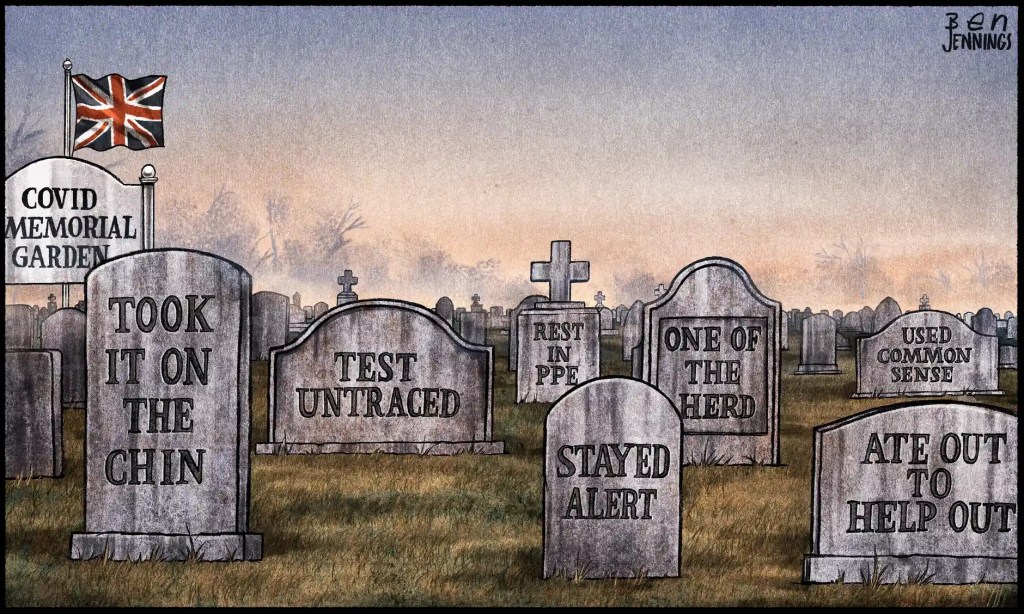
The conventional line is that the Tory government is incompetent – and of course it is. But it isn’t incompetence which very efficiently handed out £21.6 billion worth of contracts for PPE, hospital supplies and an outsourced failed test and trace system to a raft of politically connected companies and individuals;  which embraced, and then denied embracing, a herd immunity strategy; which pledged ‘whatever it takes’ funds to local authorities and then reneged on that promise; which spent £840 million on their Eat Out SuperSpreader while refusing to feed kids during half term; which for a decade ran down, underfunded and privatised our ‘world beating’ National Health Service – and then clapped as staff from overseas were shown the door in the name of taking control. None of that was due to incompetence. Rather, it was a brutal demonstration of the dominant political and economic ideology of our times – one based on individualism rather than collectivity, competition rather than mutuality, big business rather than public health – Profit before Patients, Profit before People, Profit before Life.

The death rate is obscene, and all the more so when you discover that it doubled in just 76 days – 76 days which included Christmas and the on-off opening of schools, and this current phoney lockdown. And just look at the lockdown. It designates estate agents as key workers, allows employers to insist workers come in regardless of health and safety on their commute as well as at work, keeps non-essential construction sites working, allows cleaners to go between homes but bans your mum from visiting, leaves the homeless to freeze on the street, keeps nurseries open but closes reception classes, and provides so little support that only a tiny minority of those who must self-isolate if the virus is not to spread further can afford to do so.

Two young men have been fined £10,000 each for organising a snowball fight. But where are the big fines for bosses threatening workers with the sack if they object to being put at risk? The BBC reports that between 6 and 14 January, the Health and Safety Executive (HSE) received 3,934 complaints relating to coronavirus and took enforcement action in just 81 cases, usually a verbal or written warning, with only one company facing tougher action.

Johnson and his ministers are being quite rightly castigated for saying that ‘they did everything they could’, and the list of their failures is getting longer and longer. But we are not seeing any alternative on offer.

The death rate is expected to increase exponentially over the winter months and the age groups being hospitalised and dying are becoming younger. There is a clear danger that, as vaccines are rolled out, the virus will develop the ability to bypass them through mutation, so they either don’t work, or work less well, against new variants.

Our futures cannot rely on vaccines.

They are only half the story – and can only be half of an effective strategy.

Because none of us are safe until we are all safe.

In the UK, the plan is for 14.6 million people in the top four priority groups to receive the first dose of vaccine, then 17.2 million in the next five groups. That leaves 21 million adults who may receive their first dose by the autumn – and their second three months later, by next Christmas. Those figures don’t include children and assume a steady supply of the vaccine will be available.

And, despite a good start to the UK vaccination programme – noticeably run by public sector health experts rather than privatised profiteers – the wheels are already starting to come off. Distribution is erratic, essential second doses are being delayed and, more seriously, we are seeing the beginnings of the vaccine wars, so predictable when we live in a country ruled by protectionists and nationalists, who have just bragged about brokering an acrimonious divorce from our nearest trading neighbour. A mix of EU bureaucracy, vaccine nationalism and the interests of Big Pharma are a potentially fatal combination. And of course this vaccine nationalism isn’t just about the UK and the EU. Just 25 doses of vaccine have been administered across all poor countries compared with 39 million in wealthier ones. I’ll repeat those figures – 25 compared to 39,000,000.

This is a global pandemic. None of us are safe until we are all safe.

An alternative – and additional – strategy to vaccination is essential.

Vaccination has to go hand in hand with a policy of elimination.

That is the policy which has been followed by countries as diverse as New Zealand, Taiwan, Vietnam and Australia. Closer to home, it has also been followed by the Isle of Man, which is now Covid free.

It is not too late for that policy to be adopted here. If it isn’t we will be left hanging around in on-off lockdowns waiting for the death knell for the next 100,000 of our loved ones. And then the next 100,000.

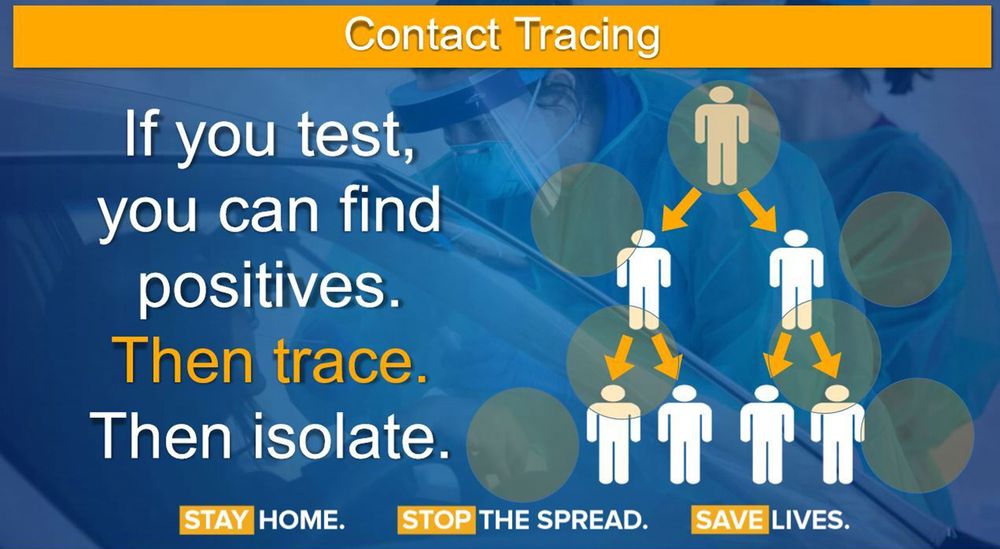
What does a proper elimination strategy involve? It needs a short, sharp, hard lockdown to drive down case numbers combined with and followed up by an effective, public sector track and trace system, comprehensive testing and quarantining for all UK arrivals. Workplaces and shops need to be made safe (the trade unions know how to do this even if employers don’t), with properly funded and supported self-isolation – either at home or in good alternative accommodation – as well as physical distancing and mask wearing. In this way community transmission of the virus can be slashed so that vaccination will have time and space to work and mutation is less likely.

Few if any of those in power seem to grasp that this strategy minimises costs and disruption to education and business, as well as saving the most lives. Instead, Groundhog Day is back – yet again the Tory right are calling for an end to the lockdown and Labour are calling for the schools to reopen. Both anthropomorphise the virus and want us to think it is going to consult its calendar to check term and bank holiday dates – half term maybe, Easter definitely!

The government can do this. It is doing it this week in response to the South African variant – testing, testing, testing (anyone else remember the WHO calling for just that last March?), using local authority public health experts, with Matt Hancock stating that they are coming down hard on the virus and that their goal is to eliminate every single case.

This is the opportunity Labour needs to embrace a full elimination strategy and, rather than piecemeal criticisms, Labour must put forward a detailed and comprehensive package of the measures that should be taken immediately if not just schools but our whole society is to be able to get on with our lives and plan for a better future.

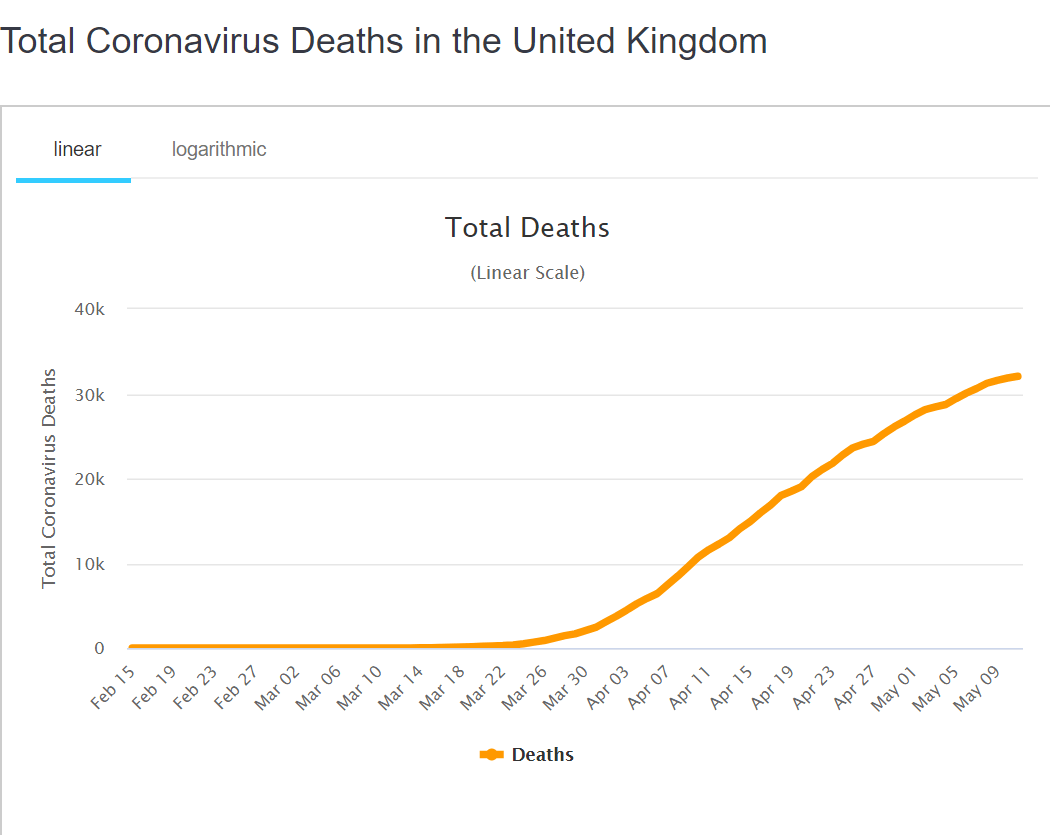
Covid’s ideological breeding ground

covid death graph
https://www.worldometers.info/coronavirus/country/uk/

Battered and depressed by the tragic details of the daily news updates and the frustrations of lockdown, it’s easy to lose sight of the big picture – and to forget that the Tory response to the Covid-19 crisis is governed by an extreme right-wing ideology which, when combined with the arrogance and greed of the British upper class, means that their decisions have little to do with saving lives, let alone the NHS.

But there are three key elements of Tory ideology we must not forget as we recoil in horror at what is happening:

  • Lansley ‘reforms’ (aka as the 2012 Health and Social Care Act), which institutionalised competition within the NHS
  • Austerity, which didn’t just starve the NHS of resources but led to follies such as the failure to replenish stockpiles of essential equipment despite the recommendations of Exercise Cygnus
  • Privatisation at every level of the economy, shrinking the state and putting profit before people.

Add to these the poisonous concept of British exceptionalism, cultivated during and by Brexit and given free rein now Boris Johnson and his ‘advisers’ are in Downing Street –the appalling and avoidable result of which is that the UK tops the European death league – and we can begin to understand why we have had to experience:

  • The herd immunity policy pushed by Downing Street’s eugenicists – more appropriately called the ‘cull the herd’ policy.
  • The strategy of mitigation rather than suppression; the failure to comply with WHO guidance to test, trace and isolate; and the refusal to lockdown and close borders at a time when it may have prevented thousands of deaths.
  • Boris’s Nightingale Hospitals – white elephants which diverted resources from existing hospitals and care homes. The questions about who profited from building these have yet to be asked.
  • The disregard and indifference towards social care and care home residents and workers. Why should we be surprised by this when the Tories have repeatedly failed to come up with any social care policy for years, let alone one which would integrate a sector dominated by private companies with the public NHS?
  • The refusal to work with Europe, not just on research and procurement, but now on data collection, with the Vote Leave data harvesters deeply involved in Downing Street’s preferred contact tracing App.
  • Private companies involved at every level – for example Deloitte, G4S, Serco and Capita are all involved in one way or another with procurement and contact testing, with data harvesting a binary choice between the US tech giants and AI firms linked to the Tories’ cronies.
  • The exposure of the health, wealth and race divides in our society, inequalities which have worsened over the past decade and which are now resulting in increased deaths in poor and multi-racial communities.

Now we must add messaging on easing the lockdown so muddled – as economic libertarianism comes into conflict with the public’s health – that key members of the Government have been unable to explain what we are all being advised to do.

1000x-1

Labour has a historically poor record of confronting the Tories on an ideological level, often letting them get away with pretending they haven’t really got one. Labour failed to challenge austerity until 2015. It tended to treat Brexit as a technical issue to do with trade and EU institutions rather than internationalism and solidarity, and was reluctant to call out its motivating mixture of deeply entrenched xenophobic bigotry, Atlanticism and the demands of a faction of capital. Labour’s response to the coronavirus crisis has similarly focussed on immediate issues rather than challenging the ideological reasons underlying the Tories’ failure to protect the health and lives of all their citizens.

This is to a large extent understandable whilst we are in the midst of the pandemic. Indeed, as one of those tagged with that horrible expression ‘extremely vulnerable’, my most frequently voiced criticism is why aren’t we all shouting louder and louder about the government’s catastrophic mismanagement of almost every single aspect of the crisis. But just as we mustn’t lose sight of the bigger picture in the now, we also need to be looking at it for the future.

One of the most depressing features of the global response to the pandemic has been the lack of international solidarity. Britain has not been alone in pursuing its own beggar thy neighbour policies. Trump’s xenophobia threatens the whole world.

The devastation being wrought by Covid-19 is massive. The global economy is in freefall, and because globalisation and technology have linked the world’s populations like never before, the coming depression will hit everyone.  By the time the pandemic is under control, millions of working people across the world will have lost not just their lives or their loved ones, but their homes and their livelihoods. Hunger and destitution will make many desperate. Add the climate crisis to the pandemic crisis and humanity’s future is bleak if the most powerful countries continue to pursue what their strong men leaders perceive as their own national interests and fail to learn the importance of international solidarity and what could be the real meaning and strength of globalisation.

In this country, if it is left to the Tories, their new normal will be a return, with a few tweaks here and there – and with a lot of failed companies and thousands of unemployed workers – to the same old system of profit first people last. To this will be added the spice of a no deal Brexit at the end of the year. As many of us would love much of our lives to return to the way they were just a few weeks ago, it is going to be hard to challenge the ‘Britain will bounce back’ concept.

But we must. Labour has to seize the opportunity to articulate our values, challenge the Tories on an ideological level, and develop a new programme that really grasps the existential challenges the world faces. Our immediate demand has to be that workers neither in the developed north nor the global south pay for the pandemic through unemployment, tax rises and poorer public services. But we then need to go much further than that.

Our last manifesto was written for a different time and for a different economic situation. Some of its policies have shown themselves to be the most vital in the current situation – the much-mocked free broadband, nationalised railways, NHS investment; other policies such as a universal basic income and a national care service are now on the agenda. But our vision has to be even greater than any of those.

Experience during lockdown has shown both the vital role of the state and which aspects of our society and economy are valuable and essential, which are desirable, and which are unnecessary. If we are serious about tackling the climate crisis then that information must be used to inform a new transformative and radical economic and industrial strategy, which goes beyond the Green New Deal and addresses new ways of working, new ways of living, a shift in the balance between the public and private sectors, and the pressing need to alter the whole basis of income and wealth distribution.

The world changed after the 1919 flu epidemic, and again following World War Two. VE Day was not just about an end to the fighting in Europe and the Allies’ collective defeat of fascism. It was a day of celebration and comradeship which paved the way for one of the most transformative periods in this country’s history. That did not happen by accident. We came together and restructured our society and economy to fight the war and rebuild after it, just as we are doing now in a smaller way to cope with the Covid pandemic. ‘No going back to the way things were’ applies just as much today as it did in 1945.

Keir Starmer rightly says we can’t go back to business as usual and that we must go forward with a vision of a better society. But what does that mean? And how do we turn the rhetoric into reality? Across the world most communities have responded to the crisis with kindness, neighbourliness, sympathy and collectivity. We must all, across the Labour movement, now make use of whatever downtime we have, and the way we can now use technology to talk to each other, to brainstorm new, imaginative and progressive ways of living and organising society. We must be ready to #BuildBackBetter;  for a future based on our movement’s collective ideas, understanding and experiences; for a future which rejects the Tories’ right-wing virus breeding ground of fragmented public services, greed and survival of the fittest, and is founded on genuine solidarity and socialism.


78323176_10159176846483009_7521445126455951360_o