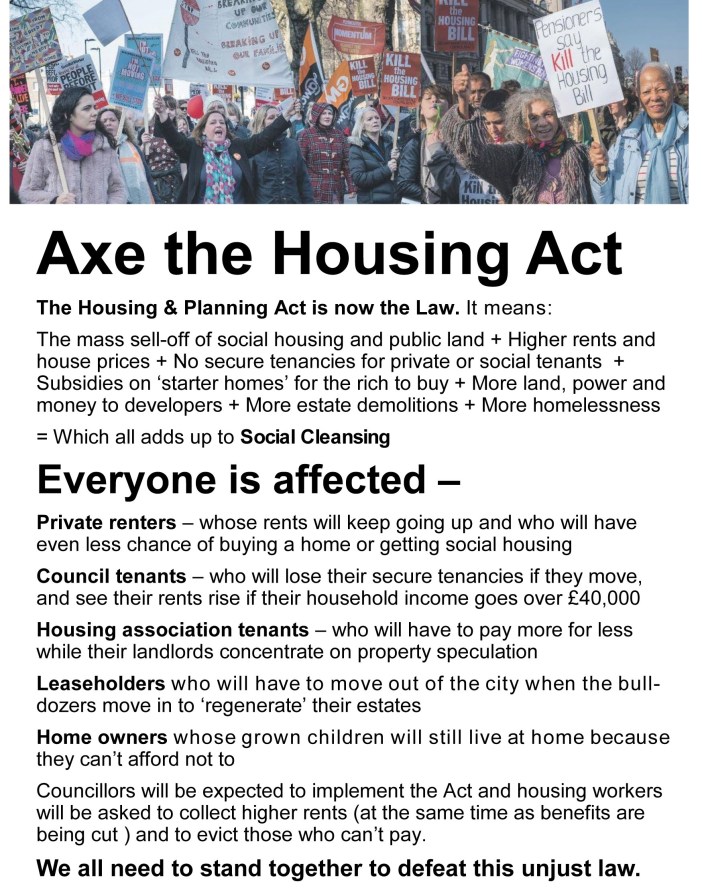
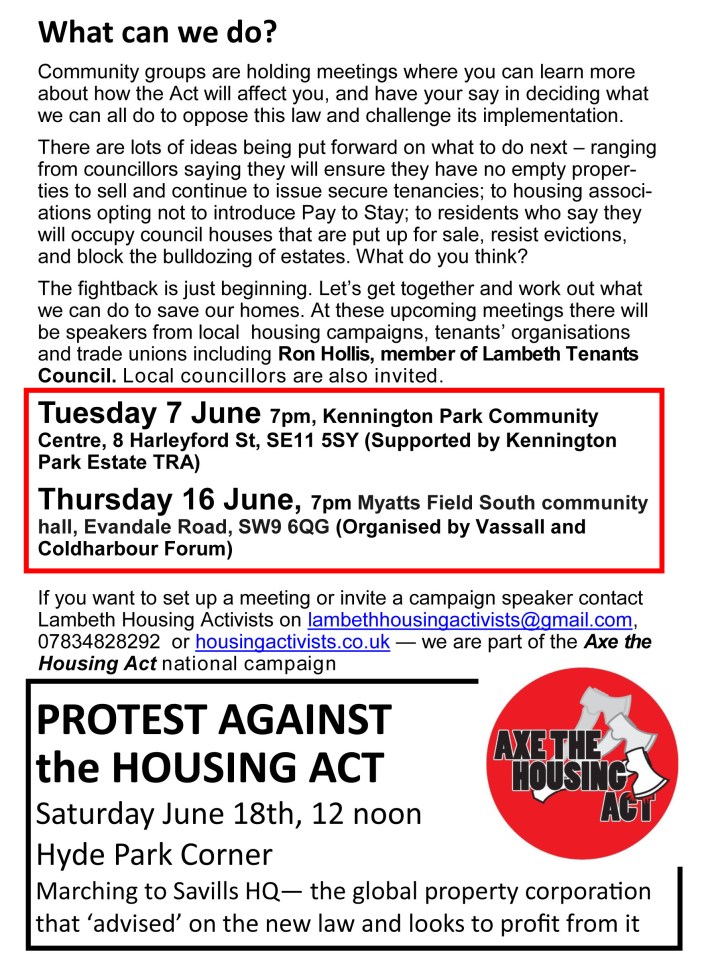
Axe the Housing Act – keep on protesting!
The House of Lords’ Amendments to the Housing Bill
Such i s the perversion of democracy in this country that the fate of working class homes is now in the hand of unelected peers and bishops.
And such are the peculiarities of the British class system that, while our old Etonian elected leaders sell off our land and homes to the highest bidders, it is lords and ladies born and bred on council estates who are leading the battle against them.
These lords and ladies have spent some weeks in Committee scrutinising the Housing and Planning Bill passed with such haste by the House of Commons on the night of 12 January and they are now reporting back. Despite having discussed a myriad amendments, only some will get voted on by the full House as only five sessions have been timetabled with the third (final) reading of the bill scheduled for 27 April.
Of the three days of report so far, some major amendments have already been passed by the Lords, defeating the Government by substantial majorities. Faced with the prospect of further defeats, the Government has also made a number of small but significant concessions.
After the third reading in the Lords, the Government can either accept their amendments or start what is known as ‘ping pong’, sending the Bill back for the Lords to try again. Both Houses have to agree the exact wording of the Bill and it could go back and forth several times. This is where we will see how determined our ermined friends are to block the destruction of our homes and lives. The Tories do not have a majority in the Lords – and their current Brin-Brexit civil war over Europe – as well as a few other little difficulties – makes it hard to predict their actions. But they used their English Votes for English Laws (EVEL) laws to push the Bill through the Commons first time round – much to the anger of the SNP – and will undoubtedly continue to use this artificially large anti-working class majority to try to reject anything coming out of the Lords.
 Time may be against them. The passage of the Bill has to be completed before Parliament is prorogued in advance of the Queen’s Speech on 18 May. If the Bill hasn’t been done and dusted – and carved into the skin of a baby goat – before that day, then it falls and they have to start all over again.
This would Kill the Bill! Fingers crossed!
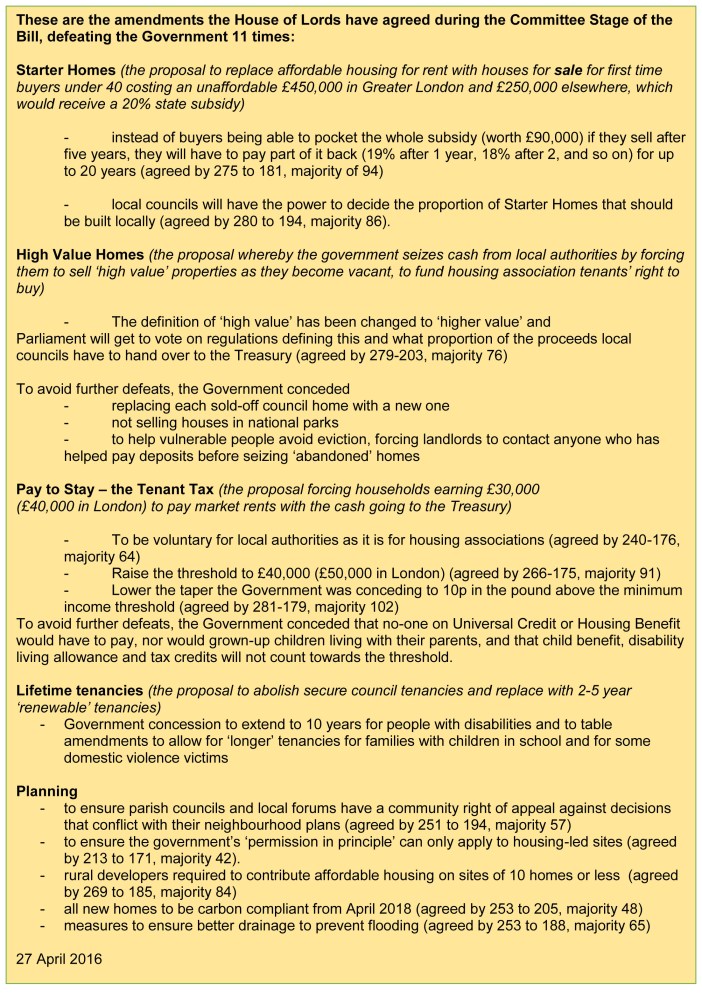

The Government has made it clear that they consider the amendments to Pay to Stay to be wrecking amendments and that they will attempt to overturn them when the Bill returns to the Commons. Let ping-pong commence!
To be continued……….
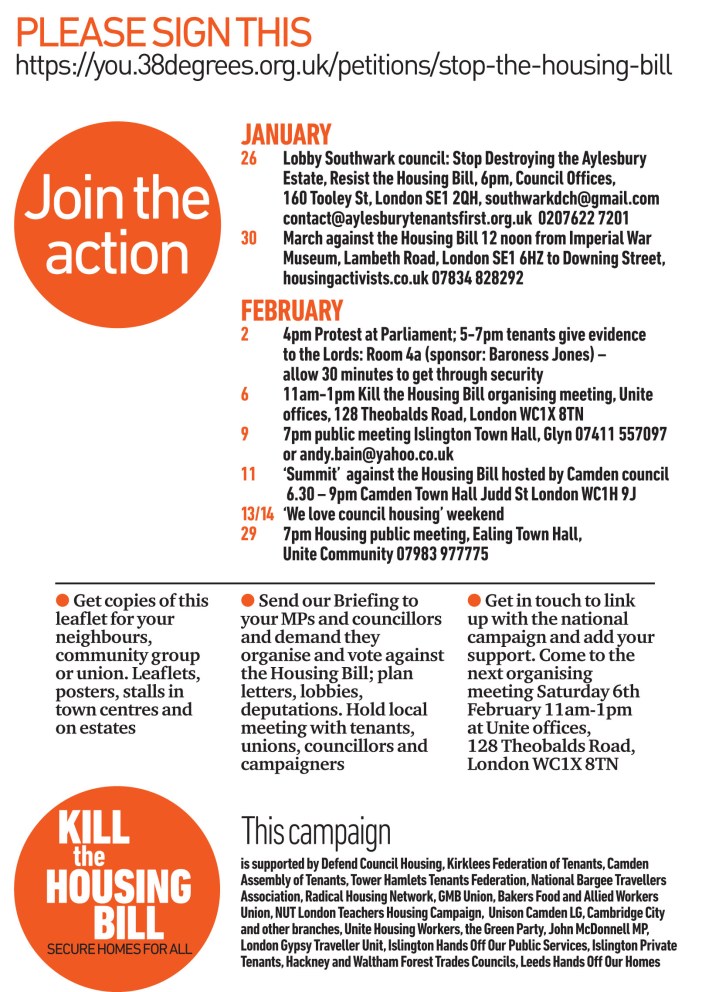
Also to be continued is the Campaign against the Housing Bill.
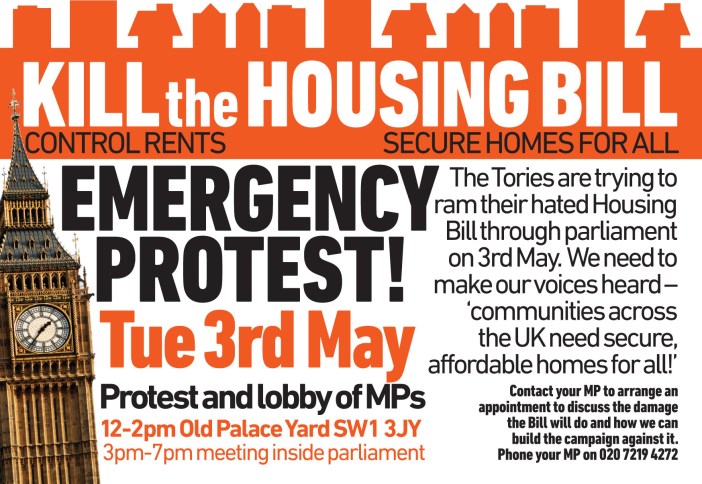
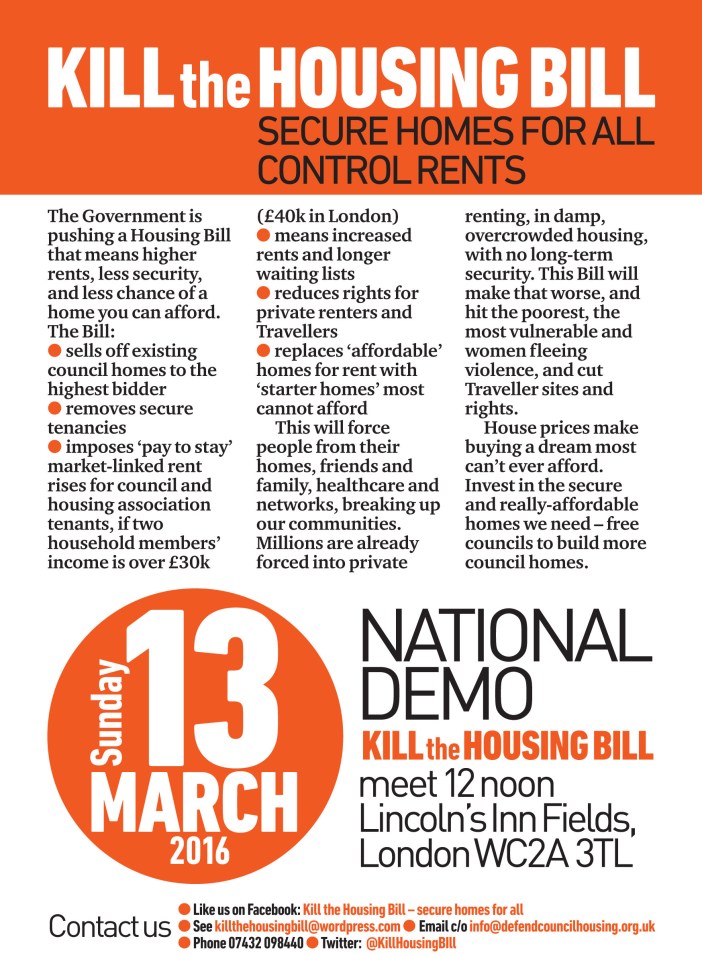
The Bill is now scheduled to return to the Commons on 3 May. There will be an emergency protest and lobby from 12-2 Old Palace Yard, SW1 3JY, and a meeting inside Parliament in Committee Room 12 from 3pm-7pm.
https://www.facebook.com/events/221362291559078/
While all these amendments are welcome, and we thank those peers who have worked so hard to build such a strong alliance of opposition to the Bill, they are no more than scraps – scraps from the high table. The fact that this Tory Government is likely to try to overturn even these scraps shows with what deep contempt they hold those of us who live in social housing and whose work creates the wealth they so flagrantly enjoy.
Whose streets? Our streets!
Whose homes? Our homes!
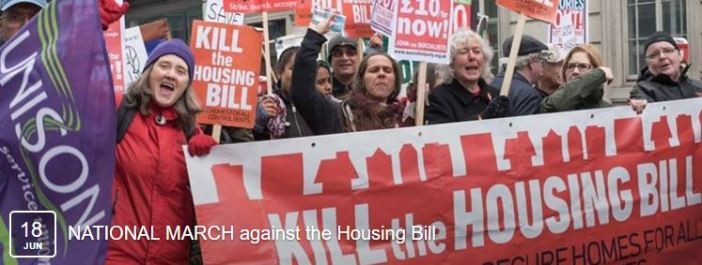
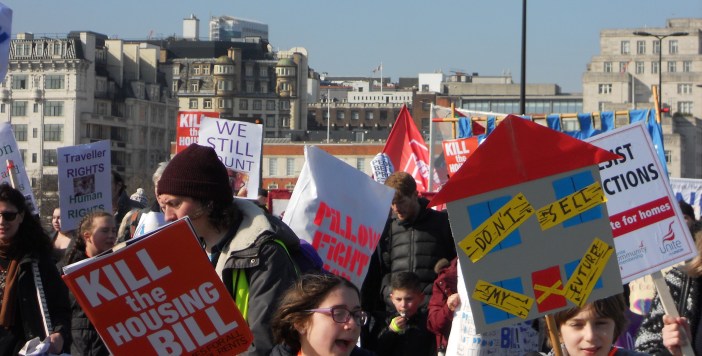
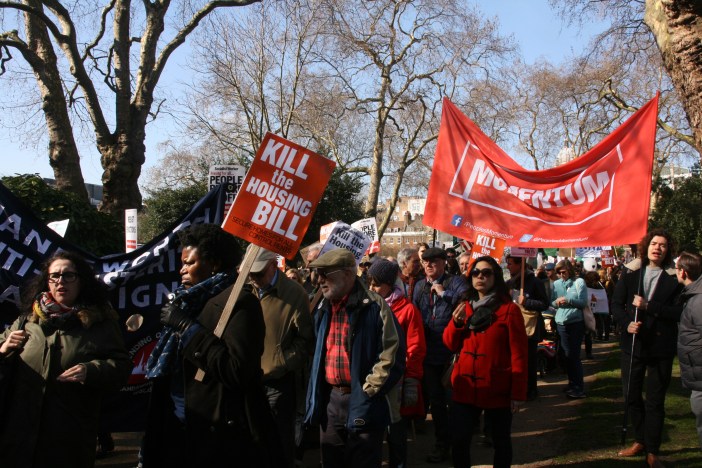
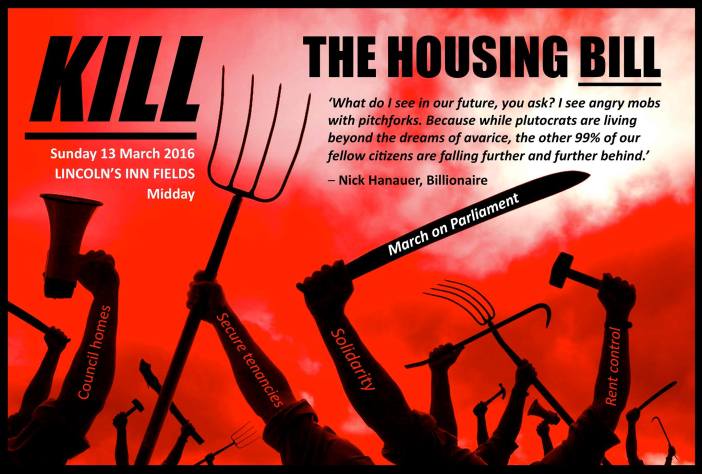
Thousands of angry tenants, housing workers, squatters, travellers, private renters, students and political activists were joined by MPs and councillors as we marched through London on a sunny March Sunday to protest the Tories’ plans to destroy public housing.
Kill the Bill! Kill the Housing Bill!
And a surprise re-entry into the top of the demo playlist, that ’40s anthem,
Maybe It’s Because I’m a Londoner!
Not surprisingly the national demo organised by the Kill the Housing Bill campaign was a tad London-centric – but then it is homes in London which are most threatened if the Tories get their way in hollowing out the city by forcing the working class out of the centre. One of the challenges for the campaign must be to build outside the capital. This Bill will affect everyone, everywhere.
The Bill is still progressing through the Lords, and crucial votes will take place soon. And there are signs that, as part of their current ‘let’s-not-scare-the-voters-too-much’ EU Remain strategy, the Tories are watering down some of the proposals such as the Pay to Stay limits and Housing Benefit caps which are leading to hostel and sheltered housing closures.
In London the mayoral election on 5 May is crucial with housing such a hot topic. A Labour Mayor with planning and building powers determined to stem the gentrification of our great working class districts can make a massive difference. Will Sadiq? I don’t know. But Labour’s Manifesto opposes the Bill and pledges “that estate regeneration only takes place where there is resident support … and that demolition is only permitted where it does not result in a loss of social housing.” The trouble is these words ring hollow to tenants in London’s Labour boroughs fighting to save their homes from demolition. The Labour leadership needs to step in and heal the rifts which have built up between councillors and residents and their supporters if we are to unite to fight the Bill.
Calls are going out from tenants’ groups that councillors should refuse to implement the Bill. Because the Bill is such a compendium of measures, there is a lot of scope for councils to investigate what they can and can’t do and share information and legal advice. As a start they can pledge not to evict anyone who refuses to Pay to Stay. Many of the measures are ‘voluntary’ for housing association landlords which have become increasingly corporate bodies in recent years and lack any real democratic or accountable ways for tenants’ voices to be heard. In my book, this means we just need to shout louder! Councillors can help us do that by bringing together council and housing association tenants.
It will be up to us to defend our homes. The march was just the beginning. Tenants are getting organised and we will Kill the Housing Bill!
for Labour Briefing, March 2016

The Tories want to clear the working class out of London. The people who built our city, who create its wealth, who turned it into one of the greatest cities in the world are to be evicted so that the Tories and their friends can turn it into a heartless, soulless ghetto for the rich and useless.
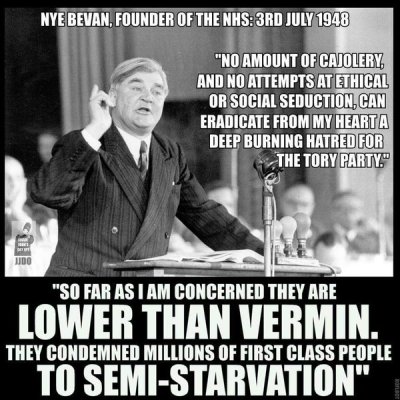
Nye Bevan’s vision of council housing when, as a key member of the post-war Attlee government, he led the building of a million homes was of a living tapestry of a mixed community where “the working man [sic], doctor and clergyman live in close proximity to each other”. His vision had at its heart a desire not only to provide decent homes, but also to enhance people’s life chances and help them make the most of their talents and abilities. It’s no surprise that the founder of the National Health Service should have understood only too well how people’s living conditions and their health and wellbeing are inextricably linked, that slums, poverty and squalor breed disease.
The estate where I live is no longer just public housing – Thatcher’s right to buy drove a wedge through that. But all generations, many races, many cultures, many faiths, many nationalities, many occupations and none, live side by side, most renting, some owning. My neighbours are pensioners and children, care home workers, lecturers, child minders, computer programmers, architects, bank clerks, artists, rail workers, gardeners, plumbers, cleaners, taxi drivers and some it’s best not to ask. Probably no doctors, but plenty of health professionals. No clergymen that I know of, but plenty of working women. It is a rich, diverse, living tapestry. It is a community.
David Cameron’s misconceived, ill-informed vision of public housing is of “sink estates”, of “brutal high-rise towers” that breed “criminals and drug dealers”. He would have us believe that public housing has failed, that it needs to be razed to the ground and what little remains should only be made available for short periods of time to those “on low incomes or otherwise disadvantaged who would find it particularly difficult to find a home on the open market”. In other words, sod that diverse, mixed, creative, stable community – let’s create some really grim, really brutal, really ‘sink’ estates where we can warehouse the criminals and drug dealers, but make sure they’re as far away from where we want to live as possible. In particular, we have to stop the lower classes living on that prime real estate in inner and central London that we want for our own.
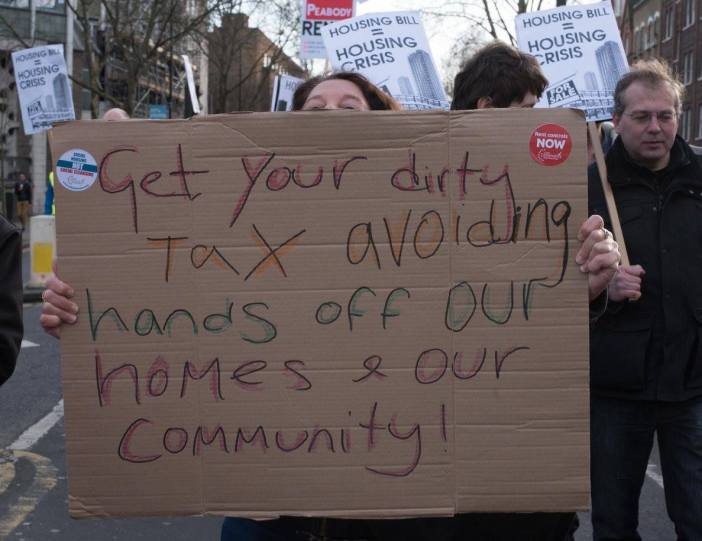
And this is what will happen if the Housing Bill isn’t stopped.
Because the Tories’ Housing and Planning Bill marks the end of public housing in this country, the demolition of Nye’s vision. It will mean
It will have its most devastating effect on our great working class capital. London is to be socially cleansed, its land offered up for grabs to the highest bidder.
It is the Great London Clearances.
Those of us who live here can feel the vultures circling, just waiting for their chance to snatch the spoils.
But it’s not just London. Across the country thousands are threatened with being thrown out of their homes, no longer able to afford the rent, no longer sure how long they will have a roof over their heads, forced away from their friends, their families, their communities.
The Bedroom Tax has already caused untold misery – including driving people to suicide. The Benefit Cap has driven hundreds out of London. How many more victims do the Tories want?
The Tories are racing to get their plans through before opposition can build. They rushed the Bill through the Commons using EVEL (how appropriate!) in the middle of the night. Now it is in the Lords where attempts are being made – led, oxymoronically, by peers brought up on council estates – to ameliorate its worst effects, but time for debate has already been cut short.

So, what exactly does this complicated Bill involve? Why is it so destructive?
Nobody will be exempt – pensioners, single parents, families with children, those in work, those on benefits, domestic violence victims, people with disabilities and/or special needs – all will be hit one way or another.
What will it not do?
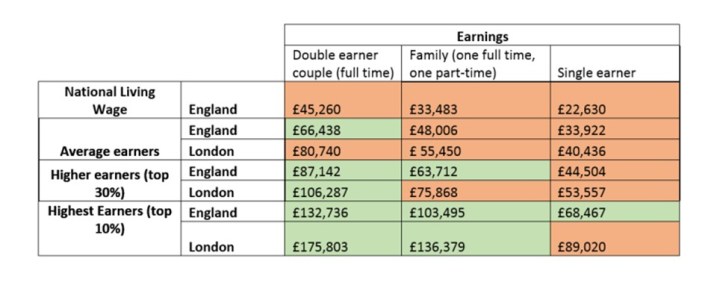
The table below from Shelter shows the different types of household who can (green) and those who can’t (orange) afford an average Starter Home. This just looks at whether their income is enough to secure a mortgage, not whether they have the deposit saved up. And it shows that London homes are out of reach to anyone but the very rich.
Housing Benefit and Welfare Cuts
And while the Housing Bill is doing all this, George Osborne is busy imposing cuts to housing benefit to finish the job.
If the Housing Bill is underpublicised and little understood, then housing benefit rules are even more so.
The Local Housing Allowance maxima is used to work out how much private renters should get in HB based on locality and household size. It is being extended to the public sector because “that’s the fair thing to do”…. What this will mean is that pensioners will be bedroom taxed by the back door – they will now only receive HB for a one-bed flat instead of the rent for that 2/3 bed flat in which they brought up their family.
And up and down the country hostels for the homeless, domestic violence refuges and supported housing schemes are closing because no account is being taken of the additional costs of staff and support in HB payments. So embarrassed have the Tories become about this, they’ve delayed its implementation for a year to carry out “impact assessments”, something they are meant to do before they legislate.
But that’s not all.
And just to add to the misery – David Cameron’s much vaunted ‘negotiations’ in respect of the European Union include changing residency requirements so that anyone applying for social housing will need to have lived in the local area for four years instead of the current two. This won’t just apply to those coming to the UK from another EU country, but also to anyone moving within Britain.
Subsidies? What subsidies?
One of the myths we have to challenge is that public housing is subsidised.
There are two ways in which social housing is subsidised. One is the cost of building it in the first place – although it is arguable that this is not a subsidy but capital infrastructure investment, no different to spending on roads, railways or hospitals. In any case, the cost of building council homes in Harlow New Town in the 1950s was £2,000 each – how many times over has that been paid off from rental income? And so little social housing has been built in the last three decades that the bulk of any costs would have been paid off in rents years ago.

The other form of subsidy is housing benefit – which is paid to renters, in work and out, in both the public and private rental sectors. The suggestion that all social housing tenants are in receipt of housing benefit is, of course, yet another way of perpetuating the council house/benefit scrounger myth. Not only are many social renters not HB claimants, but over 20% of those who do claim are in work (a percentage that has doubled since 2010), and over a third are pensioners.
The sector where HB is rising fastest is the private rental sector, which receives 40% of the £25 billion HB bill. In 2014/15 it was £9.5 billion; it is expected to rise to £10.8 billion by 2018/19. Not that it’s the tenants who are subsidised – it’s their landlords. Just as working tax credits subsidise low paying employers, so housing benefit subsidises both high charging landlords and low paying employers.
Which is why the most effective way to reduce the housing benefit bill is not the bedroom tax or the benefit cap but increased wages and pensions and private sector rent controls.
The Tories like the ‘big lie’. They do it all the time. Remember when nurses, teachers and street cleaners bust the banks? No, neither do I. But many people believe they did. The Pay to Stay Tenant Tax is based on another of these big lies – that there are ‘rich’ tenants who are being subsidised at taxpayer expense and who can afford to pay super-rents. These are the tenants who go out to work, do not receive housing benefit and therefore do not receive any subsidy.
 It is like UKIP’s Schrödinger’s immigrant – the one who’s both lazing around on benefits whilst simultaneously out there stealing British jobs.
The Schrödinger’s tenant – the lazy benefit scrounger who simultaneously earns enough to pay the Tenant Tax.
Who will be subsidised?
At the same time as denouncing benefit-scrounging-subsidised-social housing tenants, the Tories are introducing two massive new subsidies in the Housing Bill – the £100,000+ bribe to housing association tenants who buy, and the 20% taxpayer-funded discount on starter homes which wealthy first-time buyers will be able to pocket when they sell on at full market price just five years’ later (that’s a cool £90,000 on one of those London £450,000 oh so affordable homes).
As with the bankers, it’s socialism for the rich, austerity for the rest.
There is real fear growing amongst tenants as more and more learn about the Bill. Where will we live?
Will that fear turn into anger? Can we Kill the Housing Bill? Will ‘Pay to Stay’ become ‘Won’t Pay, Will Stay’?

Labour’s wringing hands approach to this Bill needs to toughen up. Years of demonising council tenants as benefit scroungers (including by some of Labour’s former frontbenchers) need to be challenged – the case for council housing has to be made afresh, which means confronting the fetish of home ownership and the widespread view that only the most ‘needy’ should be housed by the state. We want to be able to stay in our homes, not have them demolished without replacement. We want genuinely diverse, stable communities, we want to replace undemocratic, unresponsive housing managements with tenant-led bodies. We want quality homes built to high standards. We want to be able to live in our capital city.
2 March 2016
(a shorter version of this appears in Labour Briefing, March 2016)
This is what I told the Morning Star at the beginning of January:
“This Tory Housing Bill represents the wholesale privatisation and destruction of all public housing in this country. The Tories are using the housing crisis they have created to declare an underreported, misreported war on social housing tenants, local authorities and housing associations under the guise of encouraging home ownership. Working class communities will be destroyed and essential workers driven out of the cities if this Bill goes through. Homelessness, rents, insecurity and squalor will rocket. This Bill has to be stopped.”
The political is personal – the personal is political.
That’s the political bit. And this is the personal …..
It will destroy the community in which I live and on which I depend.
I have lived on this Estate for 35 years. My son went to school here, my partner died here. His ashes are buried in our Park, as will mine be. I depend on the local NHS for my complex health problems, and receive pioneering treatments not easily available elsewhere. My neighbours support me and I return that support as best I can, by teaching computing, organising activities, representing them when they have problems with our landlord. I chair our Tenants & Residents Association.
Many of the provisions in the Housing Bill could destroy my community – from driving working families away through the Pay To Stay Tax, to short-term tenancies removing any community commitment and taking away any security from people like me when we lose their partners, to plans to bulldoze whole estates without any guarantees of return.
In the time I have lived here my estate has gone from being a hard-to-let riot-prone sink estate to a highly desirable, high value piece of real estate.
The developers are circling. This Bill will open the floodgates for a massive land grab.
As Oscar Wilde nearly said: Tories understand the price of everything and the value of nothing.
I value my home. At any price.


Since the ‘Pay to Stay’ provisions in the Bill are now voluntary for Housing Associations, my Tenants Association in Kennington has joined with others in Stockwell to write to the Board of our HA, the Hyde Group, calling on them not to implement it. Our letter and Hyde’s reply can be found here.
It’s worth all HA tenants’ reps doing the same. You don’t win anything if you don’t try!
*******************
The Kill the Housing Bill campaign has produced an excellent briefing on the Bill – click here
and Vivienne Lewis has written this note about the effect of the forced sale of ‘high value’ housing in Lambeth –
The forced sale of Council housing means there will be less housing for people who need it
The forced sale of empty Council homes to finance the housing association right to buy means there will be fewer lettings available for people on the Council’s housing register and for existing council tenants who need to move to another home
Lambeth Council have estimated that they will be forced to sell 120 properties every year on the open market simply to meet the Government’s demand for cash
They also estimate that most of the homes (approximately 3/5 of the total) that they will have to sell will be family homes with two or more bedrooms
Last year Lambeth was able to provide housing to 1,200 households – so the forced sale of 120 properties means a reduction of 10% in the number of properties they will be able to offer to tenants
However, reduction in the number of homes becoming available for letting to new tenants could be even more than 10%.
This is because the changes being introduced by the Government are likely to reduce the number of lettings which become available as a result of tenant transfer.
Lettings which result from the transfer of the previous tenant account for around 30% of new lettings and include lettings of family-sized homes which become available for let as a result of local policies which encourage tenants to move to smaller homes after their families leave
The bad news, both for council tenants who want to transfer to another home and to overcrowded families on the Housing Register, is that these kinds of relets are likely to dry up as a result of the Government’s proposals.
This will happen for two reasons
– Firstly, because tenants who transfer to a new tenancy will have poorer terms and conditions than they do now so will be less willing to move and
– Secondly Councils will think twice about offering transfers to tenants if they required to sell the vacated property and hand over the money to the Government
(NB at Committee Stage the Government refused to accept an amendment which would have excluded properties becoming vacant as a result of tenant transfer from the enforced sale of high value Council properties)
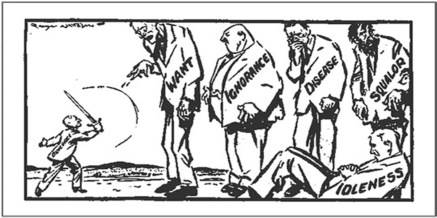
It is easily forgotten that council housing – more usually now known as social housing to include housing association homes – was one of the pillars of the post-war Welfare State.
Along with scores of working class communities up and down the country, with London hardest hit.
The Housing and Planning Bill does not stand alone. Benefit cuts will also play their part in destroying our communities and forcing families out of their homes.
The Bill involves different constituencies of interest who need to be brought together to oppose it. Each of its major provisions is an attack on public housing; taken together the whole signals total destruction.
The suppliers of public housing
Existing tenants
Potential tenants
The differences between voluntary and compulsory in respect of local authorities and housing associations comes down to the fact that the Treasury wants to reverse the recent ONS classification of housing associations as public sector bodies, whose £60bn debt must be added to government debt, by deregulating them and then privatising them by selling off the £44bn in capital grants they have received from the taxpayer over the past three decades. This would amount to a decrease in public sector debt (‘the deficit’) of more than £100bn. (Applying the compulsory rent reduction to HAs suggests George Osborne hasn’t quite worked out this deregulation thingy yet!)
Housing Benefit
It is worth noting that cuts in housing benefit have a twofold effect: (i) for the claimant they mean the choice between eating, heating or paying the rent, getting into arrears and then facing eviction, being deemed intentionally homeless and then ending up on the street; and (ii) the landlord who loses a substantial amount of previously guaranteed income/subsidy which could have been invested in the provision of more social housing.
None of this will do anything for the 1.3 million households on housing waiting lists. It will not increase the stock of available housing – not family homes at reasonable rents, nor specially adapted flats, nor sheltered housing, nor warden supported refuges or hostels – none of which are provided by the private sector – and it could throw millions onto the streets. Homelessness has risen by a third under Cameron’s premiership. How much higher will it go?
The Government’s answer to the increase in private renters suffering exploitation at the hands of Buy to Rent and Right to Buy landlords is not to deal with it by capping rents and providing secure tenancies but to make social housing tenants suffer the same unaffordable rents, insecure, overcrowded and squalid conditions; not to build the decent homes we so desperately need to be able to rent, but to sell off and demolish what social housing we currently have.
Since Thatcher introduced Right to Buy in the 1980s four out of ten council homes sold under the policy are now in the hands of private landlords. How many more homes will be privatised?
The demonisation of council tenants as benefit scroungers and criminals has been going on for decades and we have few allies beyond the world of housing professionals.
The Tories know this and are taking full advantage. The ‘scum of the earth’ are to be driven out of our cities so that the space we are taking up can become yet another piece of profitable real estate, for sale to the highest bidder.
We can Kill the Housing Bill! It potentially affects millions – not just the 4 million social renters, but the millions waiting for public housing, on the waiting lists – 22,000+ here in Lambeth – or stuck in crap private rentals, young people – and now the not so young – who can’t afford to leave home or start a family – and their parents!
Let’s join together to demand truly affordable, decent and secure housing for everyone.
And let’s start by demanding the Labour Party makes as big a fuss about this as they did about tax credits. They won that one! They can win this!
“Everyone has the right to a standard of living adequate for the health and well-being of himself and of his family, including food, clothing, housing and medical care and necessary social services, and the right to security in the event of unemployment, sickness, disability, widowhood, old age or other lack of livelihood in circumstances beyond his control.” (Article 25 of the Universal Declaration of Human Rights)
Joan Twelves, 31 December 2015
Joe Halewood has blogged more on all this at https://speye.wordpress.com/2015/12/31/social-housing-in-2016/
If the Housing and Planning Bill is designed – as we know it is – not to provide affordable housing but to remove the obligation to build it;
If the Bill is designed not to build homes for the people who need them but to subsidise private investment with public money;
If the Bill is designed not to help renters onto the property ladder but to lose more homes for social rent by extending the Right to Buy;
If the Bill is designed to sell off ‘high value’ council homes to the rich and not replace them for the poor;
If the Bill is designed to raise rents on social housing to market rates for people who cannot afford them;
If the Bill is designed to demolish existing housing estates under the banner of regeneration and replace them with starter homes for the rich;
If the Bill is designed to…
View original post 454 more words

 Joan Twelves